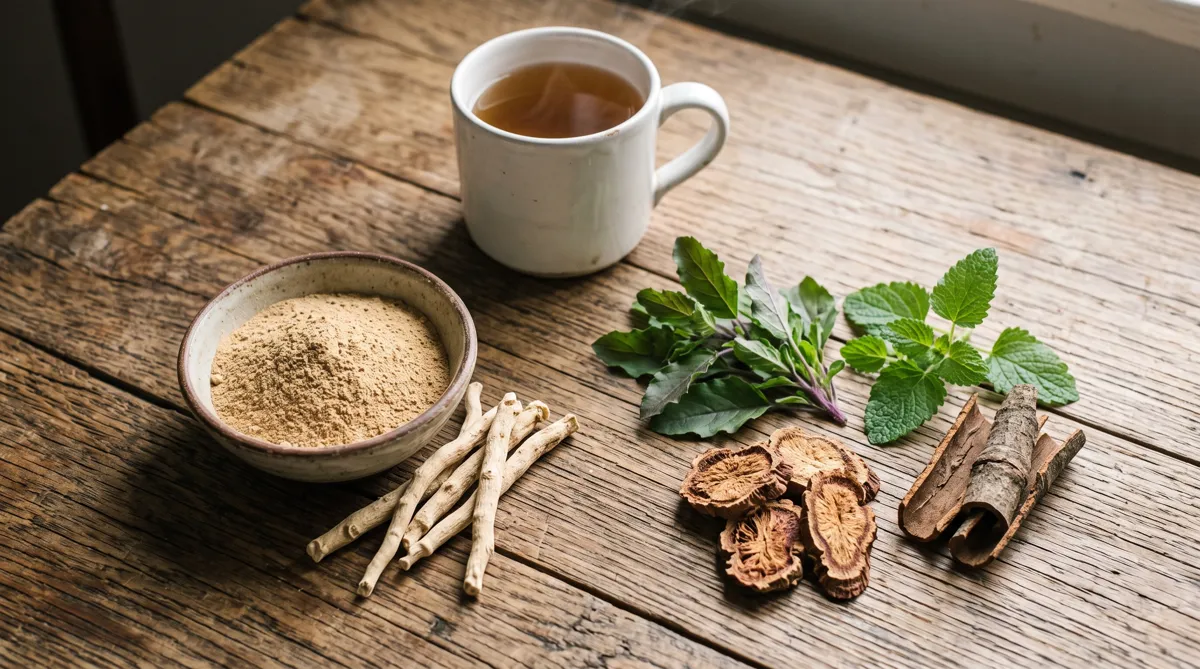
One extract or a blend of herbs: ashwagandha root and powder on the left, other herbs on the right.
This article is part of our CortiSync: The Complete Guide.
CortiSync vs Ashwagandha: 7 Herbs or 1? What Trials Show
Answer first: cortisync vs ashwagandha is a choice between a seven-herb blend and one extract. Ashwagandha alone has the stronger cortisol evidence, including a 2025 meta-analysis of randomized trials. CortiSync lists 300 mg of Sensoril ashwagandha plus six other ingredients, and we found no trial of the finished blend. See the official CortiSync page.

Affiliate disclosure: links to CortiSync on this page are affiliate links (code 618161). We may earn a commission at no extra cost to you. This page is educational and is not medical advice. These statements have not been evaluated by the Food and Drug Administration. This product is not intended to diagnose, treat, cure or prevent any disease.
Contents
Searching cortisync vs ashwagandha usually means one question: is a seven-ingredient blend worth choosing over a single, well-studied herb? We read the trial abstracts, the label and the NIH pages so you can compare them without marketing filters.
Short version: ashwagandha alone has more published cortisol data than any other single ingredient in CortiSync. The blend may offer broader coverage, but its extra ingredients carry thinner evidence and lower label doses. Neither replaces medical care for a real stress or sleep problem.
See the official CortiSync page
CortiSync vs ashwagandha: the short answer
Pick ashwagandha alone if you want the most-studied option, a simple ingredient list and control over the dose. Consider CortiSync if you prefer one capsule routine covering several calming herbs and accept that we found no trial of the finished blend.
Both routes share the same caveat. Ashwagandha trials are short and mostly small, and the 2025 meta-analysis below found that cortisol moved while perceived stress did not. Neither option should be treated as a cortisol treatment.
| Factor | Ashwagandha alone | CortiSync (manufacturer formula) |
|---|---|---|
| Ingredients | One extract | Seven ingredients, one of them Sensoril ashwagandha |
| Human evidence we opened | Randomized trials and a 2025 meta-analysis | Single-ingredient trials only; no trial of the finished blend found |
| Dose control | You choose product and dose | Fixed: the manufacturer states two capsules daily with a meal |
| Main safety flags | Liver, thyroid, pregnancy, drug interactions | Same ashwagandha flags plus more ingredients to check, such as rhodiola |
| Guarantee | Depends on the brand | The manufacturer states a 67-day guarantee |

CortiSync vs ashwagandha: what each one contains
The label on the official CortiSync page, which we read on 2026-10-11, lists seven ingredients per serving of two capsules. The amounts below are daily totals as printed there; a percent daily value is not established.
| Ingredient | Label amount per serving | Role in this comparison |
|---|---|---|
| Sensoril ashwagandha root extract | 300 mg | The ashwagandha itself, as a branded extract |
| Lemon balm herb powder | 150 mg | Add-on |
| Lichi fruit extract | 120 mg | Add-on |
| L-theanine | 100 mg | Add-on |
| Holy basil leaf extract (2% ursolic acid) | 100 mg | Add-on |
| Magnolia bark extract | 100 mg | Add-on |
| Rhodiola rosea root extract (3% rosavins, 1% salidroside) | 50 mg | Add-on |
So in a CortiSync vs ashwagandha choice, the blend already contains ashwagandha. About 300 mg of the daily serving is Sensoril, and the other 620 mg is six other ingredients.

CortiSync vs ashwagandha: the ashwagandha evidence
A 2025 systematic review and meta-analysis, which we opened on PubMed, pooled randomized trials of at least two weeks using 250 mg or more per day. It covered seven studies on cortisol and six on perceived stress, with 488 participants in total. PubMed 40746175
Cortisol fell by an average of 1.16 µg/dL (95% CI -1.64 to -0.69). Perceived stress on the Perceived Stress Scale did not change significantly (SMD -0.355, 95% CI -1.188 to 0.47). The authors note moderate heterogeneity and gaps in long-term safety data.
An earlier trial gave 64 adults with chronic stress 300 mg of a high-concentration full-spectrum root extract twice daily for 60 days. Its abstract reports better resistance to stress and self-assessed quality of life than placebo. It was a single-center study. PubMed 23439798
The NIH Office of Dietary Supplements describes ashwagandha trials as small, short and mostly from India, with larger benefits at 500 to 600 mg per day. Examine reports that studies used 250 to 600 mg of root extract, most often 600 mg split into two doses.
Our own reviews go deeper on the branded extract: Sensoril ashwagandha cortisol: what 5 trials show and Sensoril vs KSM-66.

CortiSync vs ashwagandha: do the other six ingredients earn their place?
This is where the blend either justifies itself or does not. We opened one abstract per ingredient where a human trial exists. None tested CortiSync itself, and none used the exact label extract unless stated.
L-theanine
A crossover trial of 30 adults gave 200 mg of L-theanine daily for four weeks. Depression, trait anxiety and sleep-quality scores were lower after L-theanine than after placebo. The CortiSync label has 100 mg per serving, half that trial dose. PubMed 31623400
Holy basil
A trial of 100 stressed adults used 125 mg of a standardized holy basil extract twice daily for eight weeks, measuring perceived stress, mood and sleep. The label lists 100 mg of a 2% ursolic acid extract per daily serving, so extract and dose differ. PubMed 36185698
Rhodiola
A 28-day placebo-controlled trial of 60 people with stress-related fatigue used 576 mg per day of the SHR-5 extract. Both groups improved on several scales, a reminder of the placebo effect. NCCIH says rhodiola evidence is not strong enough to judge any use. PubMed 19016404
Lemon balm
A study of single doses of lemon balm looked at mood and cognitive performance after acute dosing. That design says little about daily use for chronic stress, and the label amount is 150 mg of herb powder. PubMed 12888775
Magnolia bark and lichi
Our title searches of the PubMed index returned no human stress trial for magnolia bark extract, and we did not open one for lichi. Treat both as unproven for cortisol, whatever marketing says.
Takeaway: the add-ons have plausible but mostly small and short human data, often at doses higher than the label provides. A blend can be convenient, but it cannot borrow ashwagandha evidence for its other ingredients. See CortiSync ingredients research.
CortiSync vs ashwagandha: label dose versus trial dose
| Ingredient | CortiSync label | Dose in the trial we opened | Comment |
|---|---|---|---|
| Ashwagandha | 300 mg Sensoril per day | 300 mg twice daily (600 mg/day) of a full-spectrum extract, 60 days | Label is half of that trial dose and a different extract |
| L-theanine | 100 mg | 200 mg per day, 4 weeks | Label is half |
| Holy basil | 100 mg (2% ursolic acid) | 125 mg twice daily (250 mg/day), 8 weeks | Different extract; 100 vs 250 mg per day |
| Rhodiola | 50 mg | 576 mg per day of SHR-5, 28 days | Label is under one tenth of that trial dose |
| Lemon balm | 150 mg | Single acute doses | Not comparable to daily use |
Doses are not equivalents. Extracts, standardization and study populations differ, so this table shows direction rather than a verdict that CortiSync under-delivers or over-delivers.

CortiSync vs ashwagandha: what the manufacturer claims
The manufacturer states that one study showed a 24% reduction in cortisol versus placebo and that everyday stress dropped 62.2%. The official page, read on 2026-10-11, names no author, journal or sample size for either figure.
The same page says Sensoril was tested in fourteen human studies in one place and over twelve in another. We treat these as marketing statements, not findings, until a named paper is shown. The meta-analysis result above (-1.16 µg/dL) is the number we can source.
Many competitor pages quote strong percentages without naming a trial. If a page will not name the paper, do not use its number to decide between CortiSync vs ashwagandha.

CortiSync vs ashwagandha: safety differences
Both options share ashwagandha cautions. NCCIH says it may be safe for up to three months, long-term safety is not well established, and liver injury is rare but reported. It advises against use in pregnancy, breastfeeding, thyroid or autoimmune disorders and before surgery.
LiverTox rates ashwagandha as a likely cause of clinically apparent liver injury, usually starting two to twelve weeks after the first dose. Stop and seek care for jaundice, dark urine or itching. People with advanced liver disease should avoid it.
The blend adds variables. NCCIH reports an interaction between rhodiola and losartan, a blood-pressure drug. The NIH Office of Dietary Supplements lists possible ashwagandha interactions with thyroid, diabetes, blood-pressure, immunosuppressant and sedative drugs.
NCCIH also reminds readers that natural does not always mean safe. See its guidance on using supplements wisely. Our ingredient-by-ingredient review is who should not take CortiSync, and the basics are in is CortiSync safe.

CortiSync vs ashwagandha: price, convenience and guarantee
The manufacturer states that CortiSync is taken as two capsules daily with a meal, that a bottle is a one-month supply, and that a 67-day guarantee applies. The official page listed no per-bottle price when we read it, so check current terms there.
Ashwagandha-only products vary by brand, extract and dose, and we do not quote prices that change. Compare cost per day at the dose you plan to take and look for third-party testing. NCCIH notes that words like standardized do not guarantee quality.
Convenience is the blend’s real selling point: one routine instead of several bottles. The trade-off is that you cannot raise one ingredient without raising them all. Dosing details are in CortiSync dosage.
See the official CortiSync page
CortiSync vs ashwagandha: who should choose which
| Your situation | Leans toward |
|---|---|
| You want the deepest evidence for a cortisol marker | Ashwagandha alone, from a tested brand |
| You want to control the dose or drop one ingredient if you react | Ashwagandha alone or single ingredients |
| You like a one-routine blend and accept limited blend-level evidence | CortiSync, following the manufacturer directions |
| You take blood-pressure, thyroid, diabetes, sedative or immunosuppressant medicines | Neither until a pharmacist or doctor reviews it |
| You are pregnant, breastfeeding, or have liver or thyroid disease | Neither without medical advice |
| You have persistent stress, poor sleep or suspect high cortisol | Start with a clinician and testing first |
Our verdict: for depth of evidence, ashwagandha alone wins. For a single routine, the CortiSync blend appeals. We are an affiliate for CortiSync, which is why we show label and trial doses side by side and attribute every manufacturer claim.

CortiSync vs ashwagandha: what readers keep asking
Reddit thread titles in Google results, read without posting, keep comparing ashwagandha with L-theanine, magnesium glycinate and holy basil, and ask whether to test cortisol first. Those are the comparisons in the tables above.
Before any capsule, sleep, caffeine timing and exercise matter. If you suspect a hormone problem, read cortisol test kits and do cortisol supplements work, then speak with a clinician.
CortiSync vs ashwagandha: safety notes and medical disclaimer
This article is educational and is not medical advice. Cortisol is a hormone that doctors measure and interpret; a supplement is not a diagnosis or a treatment. Speak with a clinician if stress, sleep trouble, weight change or fatigue persists.
These statements have not been evaluated by the Food and Drug Administration. CortiSync is not intended to diagnose, treat, cure or prevent any disease. Stop any supplement and seek care if you notice jaundice, dark urine, severe itching or other worrying symptoms.
See the official CortiSync page
CortiSync vs ashwagandha: frequently asked questions
Is CortiSync better than ashwagandha alone?
Not on evidence. Ashwagandha alone has a 2025 meta-analysis of randomized trials showing lower cortisol, while we found no published trial of the finished CortiSync blend. The blend may suit people who prefer a fixed multi-herb routine. Neither replaces medical care. Official CortiSync page
Does CortiSync contain ashwagandha?
Yes. The label on the official page lists 300 mg of Sensoril ashwagandha root extract per two-capsule serving, plus six other ingredients totalling 620 mg. We read the label on 2026-10-11, and the manufacturer may change the formula. Official CortiSync page
How much ashwagandha is in CortiSync compared with trials?
The label shows 300 mg of Sensoril daily. One trial we opened used 300 mg twice daily of a different full-spectrum extract, and Examine says 600 mg per day is the most common dose studied. The figures are not equivalent because extracts differ.
Can I take ashwagandha and CortiSync together?
Not without asking a pharmacist or doctor. CortiSync already contains ashwagandha, so adding more raises the total dose and the liver, thyroid and interaction concerns described by NCCIH, the NIH Office of Dietary Supplements and LiverTox.
Does ashwagandha really lower cortisol?
A 2025 meta-analysis of randomized trials found an average drop of 1.16 µg/dL in cortisol but no significant change in perceived stress. The authors call for longer trials. The result supports a cortisol effect, not a guaranteed feeling of calm.
Is ashwagandha safe long term?
NCCIH says it may be safe for up to three months and that long-term safety is not well established. LiverTox says liver injury is rare but reported. Pregnancy, breastfeeding, thyroid and autoimmune conditions are listed as reasons to avoid it.
Do the manufacturer 24% and 62.2% claims hold up?
The manufacturer states them, but the official CortiSync page does not name the study, journal or sample size, so we cannot verify them. We rely on figures traced to abstracts we opened, such as the 2025 meta-analysis. Official CortiSync page
Who should avoid CortiSync?
People who are pregnant or breastfeeding, have liver or thyroid disease, or take blood-pressure, diabetes, sedative or immunosuppressant medicines should ask a clinician first. Our safety guide, who should not take CortiSync, goes ingredient by ingredient.
What does the manufacturer guarantee?
The manufacturer states a 67-day guarantee on the official page and a dose of two capsules daily with a meal. Terms and bundle bonuses change, so read the current offer on the official CortiSync page before ordering. Official CortiSync page
What does the manufacturer say about CortiSync?
The manufacturer states that CortiSync is a seven-ingredient formula for stress and cortisol balance. Check the current terms on the official page before you decide.
Reviewed By
Reviewed for ingredient accuracy and supplement-safety wording by Dr. John Carter, PharmD, clinical pharmacist and lead scientific reviewer at HealthySupplements.us. The review covers the sources and cautions cited here, not a personal recommendation for any reader.
Authority Sources We Opened
- Ashwagandha, cortisol and perceived stress: systematic review and meta-analysis (PubMed 40746175)
- High-concentration full-spectrum ashwagandha root extract trial (PubMed 23439798)
- L-theanine and stress-related symptoms (PubMed 31623400)
- Holy basil extract trial in stressed adults (PubMed 36185698)
- Rhodiola SHR-5 in stress-related fatigue (PubMed 19016404)
- Lemon balm single-dose mood and cognition study (PubMed 12888775)
- NCCIH: Ashwagandha
- NCCIH: Rhodiola
- NCCIH: Using dietary supplements wisely
- NIH Office of Dietary Supplements: Ashwagandha
- LiverTox: Ashwagandha
- Examine: Ashwagandha
Related Resources
- Sensoril ashwagandha cortisol: what 5 trials show
- CortiSync ingredients research
- Who should not take CortiSync
- Cortisol supplement questions answered
- Do cortisol supplements work?
- Cortisol blocker guide
- Ashwagandha for stress
- CortiSync vs competitors
- CortiSync vs other supplements
- Best supplements to lower cortisol