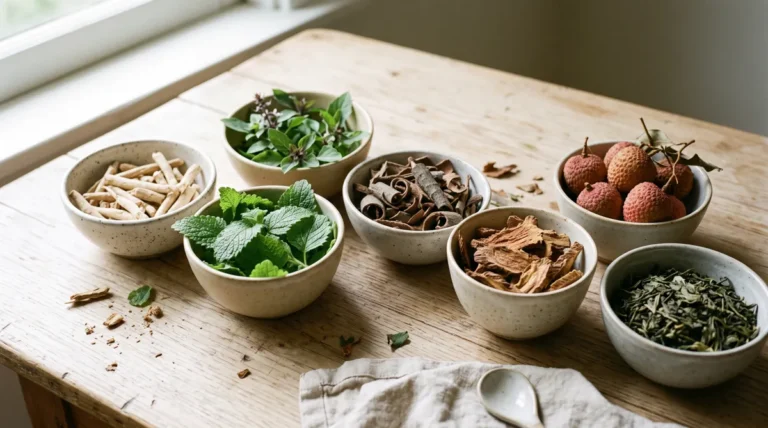
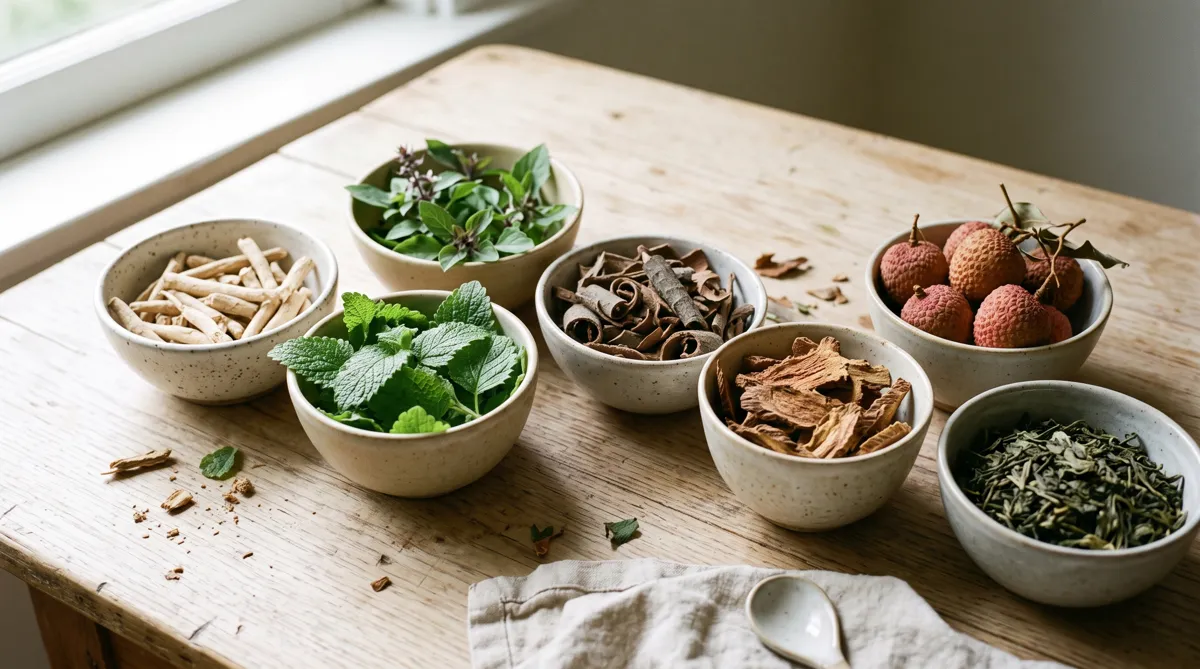
The seven plant ingredients listed on the CortiSync label.
CortiSync Ingredients Research: What Each of the 7 Shows
Answer first: the CortiSync ingredients are seven plant compounds: Sensoril ashwagandha 300 mg, lemon balm 150 mg, lichi 120 mg, L-theanine 100 mg, holy basil 100 mg, magnolia bark 100 mg and rhodiola 50 mg per two-capsule serving, per the official label. Some have human trials; the finished formula has none we could find. See the official CortiSync page.

Affiliate disclosure: links to CortiSync on this page are affiliate links (code 618161). We may earn a commission at no extra cost to you. This article is educational and is not medical advice. These statements have not been evaluated by the Food and Drug Administration. This product is not intended to diagnose, treat, cure, or prevent any disease.
Contents
The CortiSync ingredients on the label, one by one
Most pages that rank for CortiSync ingredients list the wrong plants or skip the doses. We read the supplement-facts image on the official page (checked 2026-10-11) and used only what it shows. The serving size is two capsules, and the bottle holds 30 servings. Percent daily values are not established for these plants.
| Ingredient | Amount per 2 capsules | Label detail |
|---|---|---|
| Sensoril ashwagandha root extract | 300 mg | Branded extract |
| Lemon balm herb powder | 150 mg | Melissa officinalis |
| Lichi fruit extract | 120 mg | Lychee chinensis |
| L-theanine | 100 mg | Amino acid from tea |
| Holy basil leaf extract | 100 mg | Standardized to 2% ursolic acid |
| Magnolia bark extract | 100 mg | Magnolia officinalis |
| Rhodiola rosea root extract | 50 mg | 3% rosavins, 1% salidroside |
Other ingredients on the label are vegetable cellulose (the capsule) and rice hull concentrate. These are daily totals for two capsules. The manufacturer suggests taking CortiSync with a meal. Our full dose guide is in the CortiSync dosage article.

How we checked the research behind each ingredient
Pages on the CortiSync ingredients often repeat unsourced claims. The official page states that results begin in two weeks and cites a 24% cortisol reduction, but it names no study. Our CortiSync ingredients research began on Europe PMC. We searched for for human trials on each plant and opened the abstracts. We quote only what an abstract says: sample size, dose, length and outcome. Where we found no human trial, we say so.
Three limits apply to the CortiSync ingredients in every section below. A trial on one extract does not prove another brand works the same way. Small, short trials are first signals, not proof. And no trial below tested the finished formula. For the manufacturer claims, see our CortiSync reviews and effectiveness page.

Sensoril ashwagandha: 300 mg, the anchor of the formula
CortiSync ingredients research: what Sensoril is
Sensoril is a branded ashwagandha root extract. It is the largest single ingredient among the CortiSync ingredients. Our comparison of extract types is in Sensoril vs KSM-66.
What the human research shows
A double-blind, placebo-controlled trial of 52 adults under chronic stress gave a standardized ashwagandha root extract, 300 mg twice daily, for 8 weeks (PubMed 27055824). Perceived stress, food cravings and serum cortisol improved, and the extract was reported safe and tolerable. The abstract does not name the brand.
Dose matters for the CortiSync ingredients. The trial used 600 mg a day; the label provides 300 mg a day. The two numbers are not equivalent, and we do not claim they are. The ODS fact sheet says several small, short placebo-controlled trials found lower perceived stress and cortisol, while one 2023 trial found no drop in perceived stress.
Safety notes from NIH sources
NCCIH says ashwagandha may be safe for up to three months, with drowsiness, stomach upset and diarrhea reported. LiverTox rates it a likely cause of rare liver injury, usually within 2 to 12 weeks. Details are in who should not take CortiSync.

Holy basil: 100 mg standardized to 2% ursolic acid
CortiSync ingredients research: holy basil in human trials
A registered, 8-week, double-blind trial gave 100 adults 125 mg of a standardized holy basil extract (Holixer) twice daily (PubMed 36185698). Versus placebo, perceived stress and insomnia scores improved more, and hair cortisol was lower at week 8. Salivary cortisol was also lower after a laboratory stress test.
That is a promising result for one extract. The label gives 100 mg a day of a different, 2% ursolic-acid extract, so the trial dose is 2.5 times higher. The authors reported no major adverse effects.
L-theanine: 100 mg of the tea amino acid
CortiSync ingredients research: L-theanine and stress symptoms
In a 30-adult crossover trial, 200 mg a day of L-theanine for four weeks lowered depression, trait anxiety and sleep-quality scores compared with placebo (PubMed 31623400). Participants averaged 48 years old and had no major psychiatric illness.
The label has 100 mg per serving of the CortiSync ingredients, half the trial dose. The study was small, so treat it as a lead. L-theanine is the simplest of the CortiSync ingredients to understand, since it is a single defined compound.
Lemon balm: 150 mg of herb powder
CortiSync ingredients research: lemon balm evidence
Two human studies stand out. In a crossover trial, 20 healthy adults took single doses of 600, 1000 or 1600 mg of dried lemon balm leaf; calmness and memory performance improved at the highest dose (PubMed 12888775). The label provides 150 mg, far below those amounts.
An open-label, 15-day study in 20 stressed volunteers tested a standardized lemon balm extract and reported lower anxiety and insomnia scores (PubMed 22207903). It had no placebo group, so it cannot separate the extract from expectation.
Magnolia bark: 100 mg
CortiSync ingredients research: magnolia in the research
The best-known trial used Relora, a blend of magnolia and phellodendron, not magnolia alone. In 40 stressed women (26 completed), 250 mg three times daily for six weeks reduced temporary anxiety but not long-standing anxiety; salivary cortisol and sleep did not change significantly (PubMed 18426577).
That makes magnolia, among the CortiSync ingredients, the clearest case of a gap between marketing and data. The trial does not show a cortisol drop, and the CortiSync label lists magnolia bark extract alone.
Rhodiola: 50 mg, 3% rosavins and 1% salidroside
CortiSync ingredients research: rhodiola and fatigue
A 28-day, double-blind trial of 60 people with stress-related fatigue gave 576 mg a day of the SHR-5 extract (PubMed 19016404). Burnout scores and attention improved versus placebo, and the cortisol response to awakening differed between groups. Both groups improved on several measures, a placebo effect.
On rhodiola, one of the CortiSync ingredients, NCCIH says there is not enough reliable evidence that rhodiola helps any health purpose and that most studies are low to moderate quality. The label has 50 mg, about a tenth of the trial dose. NCCIH also reports a rhodiola interaction with losartan, a blood-pressure drug.

Lichi: 120 mg and the weakest evidence
CortiSync ingredients research: what we found on lichi
We searched for human stress or cortisol trials on lychee fruit extract and found none. The lychee studies that surfaced were animal or lipid research on a polyphenol called oligonol, such as work in ovariectomized rats (PubMed 35432979). The label does not name a branded extract, so we cannot match it to any study.
In an honest ranking of the seven CortiSync ingredients, lichi has the least human evidence for stress. That does not prove it is useless; it means the claim is unsupported by what we could open.

CortiSync ingredients research: label dose vs trial dose
| Ingredient | Label (per day) | Dose in the trial we read | Evidence |
|---|---|---|---|
| Ashwagandha | 300 mg Sensoril | 600 mg standardized extract, 8 weeks (n=52) | Small RCT |
| Holy basil | 100 mg | 250 mg Holixer, 8 weeks (n=100) | RCT, different extract |
| L-theanine | 100 mg | 200 mg, 4 weeks (n=30) | Small crossover |
| Lemon balm | 150 mg | 600 to 1600 mg single doses (n=20) | Acute crossover |
| Magnolia | 100 mg | 750 mg Relora blend, 6 weeks (n=40) | Pilot, blend |
| Rhodiola | 50 mg | 576 mg SHR-5, 28 days (n=60) | RCT, different extract |
| Lichi | 120 mg | None found | No human trial found |
The pattern is clear. Every dose among the CortiSync ingredients is lower than the dose used in the matching trial, and several trials used different extracts. That is why “each ingredient has a study” is not the same as “the formula works”.
Does the combination add up? What the manufacturer states
The manufacturer states that one study showed a 24% cortisol reduction versus placebo, and a 62.2% drop in everyday stress. The official page gives no authors, journal or link for either number, so we do not repeat them as findings. It also says Sensoril has been tested in “fourteen” human studies in one place and “over 12” in another.
We found no published trial of the finished capsule. The seven CortiSync ingredients together may behave differently from any single plant, better or worse, and nobody has measured it in a controlled study that we could open. Read do cortisol supplements work for the wider evidence.

Who the CortiSync ingredients may suit, and who should skip
The CortiSync ingredients may suit adults with everyday stress who already sleep, eat and exercise reasonably, want a single multi-herb capsule, and are comfortable that the evidence is early. The official CortiSync page states a 67-day test-drive guarantee; check the current terms there before ordering.
It is not for pregnant or breastfeeding people, anyone with thyroid or liver conditions, or anyone taking diabetes, blood-pressure, sedative, seizure or immune-suppressing medicine, unless a clinician approves. See is CortiSync safe and CortiSync side effects.
Cortisol is not a diagnosis, and a supplement does not replace sleep, movement and medical care. If stress is overwhelming, speak with a professional. NIMH suggests exercise, sleep routines and less caffeine as first steps.

Safety first and medical disclaimer
Share the full list of CortiSync ingredients with your doctor or pharmacist before starting, especially before surgery. NCCIH notes that “standardized” does not guarantee quality and that natural does not always mean safe. Stop and seek advice if you notice side effects.
This article is educational. Dietary supplements are not approved by the FDA before sale. Nothing here diagnoses, treats, cures or prevents any disease.
CortiSync ingredients research FAQ
What are the CortiSync ingredients?
Per the official label, seven: Sensoril ashwagandha 300 mg, lemon balm 150 mg, lichi 120 mg, L-theanine 100 mg, holy basil 100 mg, magnolia bark 100 mg and rhodiola 50 mg per two capsules, plus a vegetable cellulose capsule and rice hull concentrate.
Has the finished CortiSync formula been tested in a trial?
We found no published trial of the finished capsule. The manufacturer cites a 24% cortisol reduction in “one study” but names none. The research we opened covers single ingredients, usually at higher doses. Check the official CortiSync page.
Which CortiSync ingredient has the strongest evidence?
Ashwagandha and holy basil have the most human data, with small randomized trials reporting lower perceived stress and some cortisol markers. Lichi has the least; we found no human stress trial.
Are the label doses the same as the trial doses?
No. Label doses are lower than the doses in the matching trials we read, and some trials used different extracts. We never claim equivalence.
Does CortiSync contain caffeine?
The seven-ingredient label we read lists no caffeine. Check the current label before ordering, and tell your doctor about all caffeine and herbs you use.
Can I take CortiSync with medication?
Ask your pharmacist first. Ashwagandha may interact with diabetes, blood-pressure, thyroid, sedative, seizure and immune-suppressing drugs, and rhodiola has been reported to interact with losartan. See our who-should-not-take guide.
How long before CortiSync works?
The manufacturer states results start in about two weeks. The trials we read ran 4 to 8 weeks, and none measured the finished formula, so timing is individual.
Is lichi proven to lower stress?
No. We found no human stress or cortisol trial on lychee fruit extract. Treat lichi as a supporting ingredient with unproven benefit.
What is the CortiSync guarantee?
The manufacturer states a 67-day test-drive with refund. Terms can change, so read the current terms on the official page before ordering. Check the official CortiSync page.
Reviewed By
Reviewed for ingredient accuracy and supplement-safety wording by Dr. John Carter, PharmD, clinical pharmacist and lead scientific reviewer at HealthySupplements.us. The review covers the sources and cautions cited here, not a personal recommendation for any reader.
Authority Sources We Opened
- NCCIH: Ashwagandha
- NCCIH: Rhodiola
- NIH ODS: Ashwagandha (health professional)
- NIH ODS: Ashwagandha (consumer)
- NIH LiverTox: Ashwagandha
- NCCIH: Using dietary supplements wisely
- NIMH: Stress
- PubMed: Ashwagandha in chronic stress (27055824)
- PubMed: Holy basil trial (36185698)
- PubMed: L-theanine trial (31623400)
- PubMed: Lemon balm crossover (12888775)
- PubMed: Lemon balm open-label (22207903)
- PubMed: Magnolia and Phellodendron (18426577)
- PubMed: Rhodiola SHR-5 (19016404)