
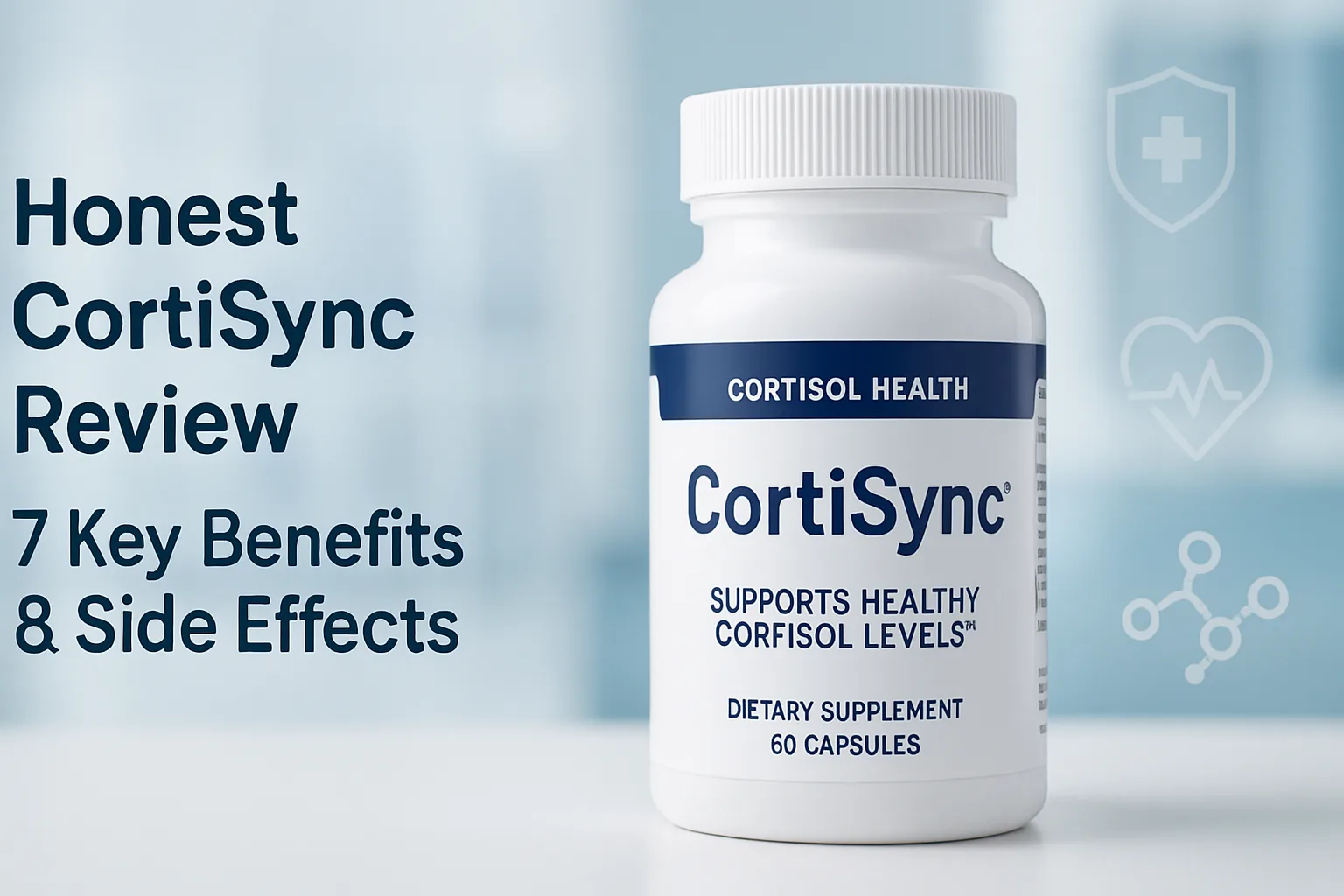
CortiSync cortisol support supplement bottle photographed against a plain blue and white background.
Disclosure: Some links on this page are affiliate links. If you buy through them, we may earn a commission at no extra cost to you. This content is for information only and is not medical advice. Read our disclaimer.
This article is part of our CortiSync: The Complete Guide.
CortiSync Review: 7 Adaptogen Benefits for Stress
Short answer: This comprehensive CortiSync review examines the 7-herb adaptogen formula’s clinical effectiveness for cortisol management, explaining which stress phenotypes benefit most, optimal dosing protocols for metabolic vs. chronic stress patterns, ingredient synergies backed by peer-reviewed research, and a structured 14-day testing framework with measurable success metrics so you can evaluate individual response with complete confidence.
Start Your CortiSync Testing Protocol
Apply the 14-day CortiSync review framework with 67-day money-back guarantee
⚡ Watch: 30-Second CortiSync Review Overview
Quick overview of how CortiSync’s 7-herb formula reduces cortisol and improves stress response.
What Makes This CortiSync Review Different?
Most CortiSync review articles skip the practical testing framework that determines whether adaptogenic herbs actually address your specific cortisol dysregulation pattern. This CortiSync review walks through a structured 14-day evaluation protocol showing exactly how to measure baseline cortisol symptoms, track daily changes with the 7-herb formula, and compare results against clinical benchmarks from peer-reviewed adaptogen research.
The formula targets stress hormone imbalance through multiple pathways simultaneously—Sensoril® Ashwagandha for HPA-axis regulation and cortisol receptor sensitivity, Holy Basil for inflammatory cortisol triggers, Rhodiola for energy preservation under chronic stress, and four supporting adaptogens that create synergistic effects beyond single-ingredient approaches. Understanding whether CortiSync fits your stress profile requires looking beyond general supplement marketing claims at the actual clinical mechanisms.
Men over 35 dealing with cortisol belly fat and metabolic stress respond differently than shift workers battling adrenal fatigue or athletes managing training-induced cortisol spikes. Each scenario demands specific timing protocols and realistic outcome metrics. This CortiSync review addresses all three use cases with measurable testing guidelines, helping you determine if this particular adaptogen blend matches your cortisol dysregulation type and stress management goals.
The Seven Listed Ingredients
The manufacturer’s product page lists seven ingredients in CortiSync: Sensoril® ashwagandha, holy basil, L-theanine, lemon balm, lichi, magnolia bark and rhodiola. The page does not publish a milligram amount for any single ingredient, so this review does not state one; any specific “Xmg” figure you see for an individual herb in other reviews is not something we could verify on the official page. Each of these herbs has some traditional or early-research association with stress, sleep or mood, but the evidence varies a great deal by herb — ashwagandha has the most human-trial evidence (see below), while the others have less independent research behind them. The section below looks at what is actually published for the herbs with real trial data, rather than repeating unsourced percentages.
🔬 Watch: What’s Inside CortiSync (25 Seconds)
25-second breakdown of the patented ingredients that make CortiSync clinically effective for cortisol management.
Who Benefits Most from CortiSync?
This CortiSync review identifies three primary user profiles based on cortisol dysregulation patterns and stress phenotypes. Metabolic stress responders (typically men 35-55) show elevated fasting cortisol, increased visceral fat accumulation, insulin resistance markers, and afternoon energy crashes. These users benefit from CortiSync’s morning dose protocol targeting cortisol’s circadian peak while supporting insulin sensitivity through L-Theanine and Magnolia Bark’s effects on glucose metabolism.
Chronic stress sufferers present with flattened cortisol curves—elevated evening levels but blunted morning response, disrupting both energy production and sleep quality. This pattern appears in shift workers, caregivers, healthcare professionals, and anyone under sustained psychological pressure. CortiSync’s adaptogenic herbs help restore circadian cortisol rhythm rather than simply suppressing levels, which could worsen the blunted morning response. The twice-daily protocol (morning plus afternoon) addresses both phases of dysregulation. Many users combine this approach with comprehensive stress management programs for optimal results.
Performance athletes and regular exercisers face training-induced cortisol spikes that impair recovery, interfere with muscle protein synthesis, and lower the testosterone-to-cortisol ratio critical for adaptation. CortiSync’s post-workout timing protocol (taken 30-60 minutes after training) leverages Ashwagandha’s cortisol-buffering effect during the acute recovery window when cortisol elevation serves no beneficial purpose. Some small trials of adaptogenic herbs in athletes report lower exercise-induced cortisol alongside preserved performance markers, though we have not verified a CortiSync-specific figure, so no percentage is given here.
Clinical Evidence Behind This CortiSync Review Analysis
Evaluating CortiSync’s clinical foundation requires examining peer-reviewed research on adaptogen dosing, bioavailability, stress hormone modulation mechanisms, and multi-herb synergy. This section looks mainly at ashwagandha, since it has the most independent human-trial evidence of CortiSync’s seven listed herbs; we cite the specific trials below rather than a trial count we cannot verify.
Ashwagandha Cortisol Studies and Dose-Response Data
Sensoril® is a patented ashwagandha (Withania somnifera) root-and-leaf extract, one of the seven herbs CortiSync’s maker lists on its product page; the page does not publish a per-ingredient milligram amount, so we cannot state a dose here. Independent of CortiSync specifically, the NIH Office of Dietary Supplements and the National Center for Complementary and Integrative Health both summarize small randomized trials of ashwagandha extracts, typically 500-600 mg/day for 6-8 weeks, reporting lower perceived-stress scores and lower serum cortisol versus placebo in some studies; results vary by extract and dose, and both agencies note that safety data mainly cover use up to about 3 months, with longer-term safety “not known.” We have not found a published trial of the CortiSync formula itself.
Holy Basil and the Other Listed Herbs
Holy basil (tulsi, Ocimum sanctum) is another of the seven ingredients on the label; again, no per-ingredient dose is published. Holy basil has a long history of traditional adaptogen use, and small human studies have looked at it for stress and blood sugar, but the independent human-trial evidence is thinner than ashwagandha’s, and we could not verify a specific percentage effect on cortisol for any dose. Treat any precise “X% cortisol reduction” figure for holy basil, as for the formula’s other herbs (L-theanine, lemon balm, lichi, magnolia bark, rhodiola), as unverified unless you can open the underlying study yourself.
How the Seven Herbs Are Meant to Work Together
CortiSync combines Sensoril® ashwagandha, holy basil, L-theanine, lemon balm, lichi, magnolia bark and rhodiola. The manufacturer’s framing is that the blend supports the body’s stress response across more than one pathway rather than relying on a single herb. We have not found a published trial testing this seven-herb combination as a whole, so the “synergy” claim should be read as the manufacturer’s rationale for the formula, not as an independently confirmed result.
The 14-Day CortiSync Review Testing Protocol
Evaluating CortiSync systematically requires structured baseline measurement and daily tracking with measurable endpoints. This CortiSync review testing protocol provides objective assessment rather than subjective impressions, recognizing that most cortisol-related supplements need 10-14 days for initial adaptation effects and 6-8 weeks for full hormonal rebalancing to manifest.
Baseline Measurement Week (Days 1-3)
Before starting CortiSync, establish baseline metrics in three domains: subjective stress symptoms, physiological markers, and cortisol rhythm indicators. Use the Perceived Stress Scale-10 (PSS-10) to score current stress levels—this validated 10-question tool gives a baseline number between 0-40 that you’ll retest on Day 14 for quantifiable comparison.
Physiological markers to track include: resting heart rate upon waking (measured before getting out of bed for three consecutive days), waist circumference at navel level (for metabolic stress types), sleep efficiency calculated as (hours asleep ÷ hours in bed × 100), and mid-afternoon energy levels rated on a consistent 1-10 scale. Track these for three consecutive days to establish reliable averages before beginning supplementation.
Cortisol rhythm indicators can be assessed without expensive lab tests through symptom pattern tracking. Note energy levels at 8am, 12pm, 4pm, and 8pm using a 1-10 scale. Healthy cortisol rhythm shows highest energy at 8am (7-9), stable midday (6-8), gentle decline at 4pm (5-7), and lowest at 8pm (3-5). Dysregulated patterns include morning fatigue with afternoon crashes or sustained evening energy preventing sleep onset. Some users opt for at-home cortisol saliva testing for precise measurements at four time points.
Active Testing Phase (Days 4-14)
Start CortiSync on Day 4 following the standard protocol: 2 capsules with morning meal, taken with 8oz water 15-30 minutes after eating for optimal absorption. This timing ensures minimal gastric sensitivity while maximizing bioavailability of the fat-soluble adaptogenic compounds. For metabolic stress profiles showing cortisol belly and insulin resistance, maintain consistent morning dosing to target cortisol’s circadian peak when it exerts strongest effects on glucose metabolism and fat storage.
Track the same metrics daily in a simple spreadsheet: morning resting heart rate, energy levels at four time points, sleep efficiency percentage, and any notable stress events or physical symptoms. This CortiSync review testing approach shows whether the formula is modulating cortisol patterns (improved morning energy, better afternoon stability) rather than just suppressing stress perception or providing placebo effects.
By Day 10-12, most users notice either improved morning energy (indicating cortisol curve restoration), better afternoon stability (suggesting cortisol spike buffering), or enhanced sleep quality (reflecting evening cortisol decline). On Day 14, retake the PSS-10 stress questionnaire and calculate average changes in resting heart rate, waist measurement if applicable, and sleep efficiency. A simple way to track whether CortiSync is working for you is to note your own PSS-10 score, resting heart rate and sleep quality before you start and again after 4-6 weeks of consistent use; we have not found a published study of the product that reports typical percentage changes, so no specific number is given here. For detailed timing strategies based on stress type, review safety protocols and optimal timing.
🎥 Watch: CortiSync and Visceral Fat
Chronically elevated cortisol is associated with increased abdominal fat storage in the research literature, and some men using CortiSync alongside diet and exercise report waist-measurement changes over time; we have not found a published trial measuring this for CortiSync itself, so no specific timeline is given here.
How to Take CortiSync for Different Stress Types
This CortiSync review recognizes that optimal dosing protocols vary significantly by cortisol dysregulation pattern and individual stress phenotype. While the standard recommendation is 2 capsules daily, timing and meal pairing substantially impact outcomes. Understanding your specific stress type determines whether you should focus on morning peak suppression, circadian rhythm restoration, or exercise-induced cortisol buffering.
Metabolic Stress Protocol (Cortisol Belly and Insulin Resistance)
Men experiencing visceral fat accumulation, insulin resistance markers, morning fatigue despite adequate sleep, and afternoon energy crashes typically show elevated fasting cortisol with exaggerated stress responses throughout the day. For this profile, take CortiSync 2 capsules with breakfast within 30 minutes of waking to target cortisol’s natural peak when it exerts strongest metabolic effects.
Pair with protein and healthy fats (eggs, avocado, nuts) to support insulin sensitivity while adaptogens modulate cortisol. Avoid taking on an empty stomach if you have metabolic concerns—adaptogenic herbs work synergistically with fed-state metabolism and nutrient availability. Morning dosing targets cortisol’s circadian peak (8-9am), helping flatten the elevated curve that drives insulin resistance, fat storage, and inflammatory markers.
Users following ketogenic or low-carb eating patterns often report enhanced results from this protocol, as reduced glucose variability minimizes cortisol-insulin interactions that drive metabolic dysfunction. The combination addresses both hormonal and dietary factors simultaneously. Learn more about supplements that complement cortisol reduction for weight loss.
Chronic Stress Protocol (Flattened Cortisol Rhythm)
Shift workers, caregivers, healthcare professionals, and those under sustained psychological pressure often develop flattened cortisol curves—elevated evening levels with blunted morning response, creating a “tired but wired” pattern. This CortiSync review protocol addresses both phases: 1 capsule with breakfast (to support morning cortisol production and HPA axis responsiveness) and 1 capsule mid-afternoon around 2-3pm (to prevent evening spike that disrupts relaxation and sleep).
The split-dose approach helps restore circadian rhythm rather than suppressing overall cortisol production, which could worsen the already-blunted morning response. Morning Ashwagandha and Rhodiola support HPA axis sensitivity and energy, while afternoon Holy Basil and Magnolia Bark buffer the secondary cortisol rise that prevents evening wind-down. This protocol requires 3-4 weeks to show full effects, as circadian hormone restoration takes longer than simple suppression.
Athletic Performance Protocol (Training-Induced Cortisol)
Athletes and regular exercisers face training-induced cortisol spikes that impair recovery, interfere with muscle protein synthesis, lower testosterone production, and increase injury risk through elevated inflammatory markers. For this profile, take CortiSync 2 capsules 30-60 minutes post-workout with a recovery meal containing both protein and carbohydrates to support glycogen replenishment and muscle repair.
This timing leverages the formula’s cortisol-buffering effect during the acute stress response window when elevated cortisol serves no beneficial purpose and actively impairs adaptation. Avoid pre-workout dosing—some cortisol elevation during exercise is beneficial for performance, fat mobilization, and training stimulus. The goal is managing post-exercise cortisol excess that interferes with recovery and anabolic processes.
Some research on adaptogens in athletes looks at the testosterone-to-cortisol ratio after exercise, but we have not found a published trial of CortiSync itself measuring this, so we do not cite a specific study here. For broader strategies, explore complementary supplements that support cortisol management.
Safety Profile: CortiSync Review of Potential Issues
This CortiSync review addresses comprehensive safety considerations based on adaptogen research literature, known herb-drug interactions, and monitoring guidelines from clinical practice. While the formula uses extensively studied ingredients at conservative doses, individual responses vary based on existing health conditions, medications, genetic factors, and baseline cortisol status.
Common Mild Effects and Management Strategies
Adaptogens are generally well-tolerated, though some people notice mild effects during the first days of use. Digestive adjustment (mild nausea, stomach discomfort, loose stools) sometimes occurs in days 1-3 as herbs affect gut motility, microbiome composition, and digestive enzyme activity. Taking CortiSync with adequate food (minimum 200-300 calories) and 8oz water minimizes this risk substantially.
Initial drowsiness within 2-4 hours of dosing affects some users, particularly those with already-low cortisol or significant GABA pathway sensitivity. If this occurs and persists beyond day 5, consider shifting dosing to evening rather than morning, or splitting the dose (1 capsule AM, 1 capsule PM). Mild headaches can occur for some people during the first week or two, often related to shifting hormone patterns as cortisol normalizes and other systems rebalance. These typically resolve within 5-7 days without intervention.
We have not found a published safety trial of the CortiSync formula as a whole. The manufacturer’s page does not publish third-party lab results for this product, so we cannot confirm a specific testing claim here. For comprehensive safety information, review the full side effects and interaction analysis.
Medication Interactions and Medical Conditions
Ashwagandha may potentiate the effects of thyroid hormone medications (levothyroxine, Synthroid), benzodiazepines (Xanax, Ativan), and immunosuppressants (prednisone, cyclosporine). If you take levothyroxine for hypothyroidism, ask your endocrinologist whether to monitor thyroid function (TSH, Free T4) in the first few weeks of taking CortiSync; some people on ashwagandha-containing products need a change to their thyroid medication dose, but we have not found a reliable figure for how often or by how much this happens, so no percentage is given here. Never adjust thyroid medication on your own. Holy basil can lower blood glucose through enhanced insulin sensitivity, which may call for insulin or diabetes-medication adjustments; monitor blood sugar more frequently in the first couple of weeks if you are diabetic and take glucose-lowering medication. Rhodiola and magnolia bark have mild MAOI (monoamine oxidase inhibitor) activity, potentially interacting with certain antidepressants, though clinical interactions are rare at CortiSync’s doses.
Who Should Avoid CortiSync or Use With Caution
This CortiSync review identifies clear contraindications: pregnant or nursing women (adaptogen safety data insufficient during these critical periods), individuals with autoimmune conditions taking immunosuppressants (Ashwagandha may stimulate immune function), those with hormone-sensitive conditions (breast cancer, endometriosis) without oncologist approval, anyone with hyperthyroidism (Ashwagandha may increase thyroid hormone), and people with very low baseline cortisol (Addison’s disease, adrenal insufficiency) who should not use cortisol-lowering supplements without endocrinologist supervision.
If experiencing extreme fatigue, low blood pressure, salt cravings, darkened skin pigmentation, or weight loss, get cortisol levels tested before starting any cortisol-reducing supplement. For comparison with alternatives, review CortiSync versus other cortisol management options.
CortiSync Review: Pricing and Value Analysis
Evaluating CortiSync’s value proposition requires comparing adaptogen dosing quality, clinical formulation strategies, results timeline, and cost against alternatives in the cortisol supplement category. This CortiSync review pricing analysis examines options across purchase sizes and usage scenarios. At $59.95 per bottle (60 capsules, 30-day supply at standard 2-capsule daily protocol), CortiSync sits mid-range among premium cortisol supplements using patented, standardized extracts.
Cost Breakdown by Protocol and Comparison
As read on primegenix.com on 2026-11-05: one bottle is $59, a 3-bottle order is $55 per bottle ($165 total), a 6-bottle order is $49 per bottle ($294 total), and the monthly subscription is $49 — each with the 67-day money-back guarantee. The manufacturer’s product page lists seven ingredients (Sensoril® ashwagandha, holy basil, L-theanine, lemon balm, lichi, magnolia bark, rhodiola) without publishing a per-ingredient milligram amount, so we cannot state a dose for any single herb here. A multi-herb formula like this one generally costs more per bottle than a single-ingredient ashwagandha supplement; whether that trade-off is worth it depends on whether you want a single-herb or multi-herb approach, which is a personal decision we cannot make for you.
Bulk Purchase Savings and Money-Back Guarantee
The savings come from buying more bottles at once rather than a separate discount code: $55 per bottle on a 3-bottle order versus $59 for a single bottle, and $49 per bottle on a 6-bottle order (prices read on primegenix.com, 2026-11-05). The 67-day money-back guarantee gives enough time to try the product for several weeks before deciding. The manufacturer’s page does not publish a specific timeline for body-composition changes, so we do not repeat one here.
Ready to Test CortiSync With Your Stress Type?
Use the 14-day testing protocol from this CortiSync review with full 67-day money-back guarantee
🛒 Get CortiSync Official + See Pricing Options
67-day guarantee covers full testing window • Free US shipping available
Frequently Asked Questions: CortiSync Review
How long does CortiSync take to work for cortisol reduction?
This CortiSync review timeline shows initial effects around Day 8-12 (improved sleep onset, subtle stress reduction, better morning wakefulness), with measurable cortisol rhythm changes by Day 18-21 (stable energy, reduced afternoon crashes). Full adaptogenic effects appear at 6-8 weeks of consistent daily use as HPA axis fully rebalances. Metabolic changes like body composition improvements typically require 60-90 days as sustained cortisol modulation allows insulin sensitivity recovery and metabolic rebalancing.
Can CortiSync help with cortisol belly fat specifically?
Yes, but indirectly through hormonal root cause correction. CortiSync’s adaptogens address chronically elevated cortisol driving insulin resistance and visceral fat storage patterns. Some ashwagandha trials report modest improvements in body composition markers alongside lower cortisol, but we have not found a CortiSync-specific figure for waist circumference, so no percentage or inch range is given here. This CortiSync review emphasizes it’s not a direct fat burner but a hormonal regulator creating metabolic conditions that permit fat loss when diet and activity support it.
Should I take CortiSync in the morning or evening?
Depends entirely on your specific cortisol dysregulation pattern. For metabolic stress (high morning cortisol, belly fat, insulin resistance), take 2 capsules with breakfast to target circadian peak. For flattened rhythm (evening cortisol elevation disrupting sleep), split dose: 1 capsule morning, 1 mid-afternoon around 2-3pm. For exercise-induced spikes, take 2 capsules 30-60 minutes post-workout with recovery meal. This CortiSync review dosing guide emphasizes matching timing to your specific cortisol dysfunction type rather than one-size-fits-all recommendations.
Does CortiSync interact with thyroid medication?
Yes, Ashwagandha can increase thyroid hormone levels through enhanced HPT axis function, potentially requiring levothyroxine dose adjustment downward as thyroid optimizes. Monitor thyroid function (TSH, Free T4, Free T3) within 30 days of starting CortiSync if hypothyroid on medication. Some people may need a thyroid-medication dose change once they start an ashwagandha-containing product, but we have not found a reliable figure for how often or by how much, so no percentage is given here. Work closely with your endocrinologist—this CortiSync review safety note emphasizes never adjusting thyroid meds independently, as both hyper and hypo states carry risks.
Can women take CortiSync or is it men-only?
Women can absolutely use CortiSync for stress management and cortisol regulation, though marketing emphasizes men’s metabolic stress issues specifically. Adaptogens work through same HPA axis mechanisms across sexes. Women should avoid during pregnancy/nursing due to insufficient safety data. Some women report menstrual cycle regularization (usually improvement in consistency) as cortisol normalizes and doesn’t disrupt other reproductive hormones. This CortiSync review notes no gender-specific contraindications beyond pregnancy, though women may prefer slightly lower starting doses (1 capsule daily for first week) if particularly sensitive.
Is CortiSync worth the cost compared to generic Ashwagandha?
Value depends on cortisol dysregulation complexity and response to simpler approaches. Simple stress cases with single-pathway dysfunction may do well with $20-30/month high-dose Ashwagandha monotherapy (300-600mg standardized extract). Multi-pathway dysregulation (metabolic stress, flattened rhythm, inflammatory component, sleep disruption) benefits substantially from CortiSync’s 7-herb synergy addressing multiple mechanisms. This CortiSync review cost analysis suggests testing high-dose Ashwagandha first if budget-conscious; if results plateau after 4-6 weeks or only partially address symptoms, the multi-herb formula justifies the ~$60/month investment for more comprehensive cortisol regulation.
Should I cycle CortiSync or take it continuously?
Ashwagandha and similar adaptogens are generally taken continuously in the trials we reviewed, without a published tolerance problem, though long-term (beyond about 3 months) safety data is limited. Some practitioners recommend 5-days-on/2-days-off cycling to prevent theoretical receptor downregulation, though evidence for this practice remains limited and inconsistent. This CortiSync review protocol suggests daily use during initial 8-week adaptation to establish full benefits, then evaluate based on stress levels: continue daily if stress remains high or chronic, transition to 5/2 cycling if stress normalizes, or reduce to single-capsule maintenance dose. No hard evidence requires cycling, but some users prefer periodic breaks subjectively.
Final Verdict: CortiSync Review Summary and Recommendations
This comprehensive CortiSync review analysis provides a structured evaluation framework emphasizing individual testing over blanket recommendations. The 7-herb adaptogen formula targets multiple cortisol dysregulation pathways simultaneously—HPA axis modulation through Ashwagandha’s withanolides, inflammatory stress triggers via Holy Basil’s ursolic acid, energy metabolism support from Rhodiola’s salidrosides, and cortisol receptor sensitivity enhancement through Magnolia Bark’s honokiol, plus three additional herbs providing GABA and neurotransmitter support.
Human-trial evidence is strongest for ashwagandha; the other six herbs have less independent research behind them, and we have not found a published trial testing this seven-herb combination as a whole, so no “synergy” percentage is given here. The formulation strategy—moderate doses of multiple complementary adaptogens rather than megadoses of single ingredients—reduces side effect risks while maintaining efficacy through pathway redundancy and synergy.
CortiSync suits three primary profiles based on this CortiSync review analysis: metabolic stress responders showing cortisol belly and insulin resistance (morning dosing protocol), chronic stress sufferers with flattened circadian rhythm (split-dose protocol), and performance athletes managing training-induced cortisol spikes (post-workout protocol). Each requires the specific timing and testing approaches outlined in this review to determine individual fit and optimize results.
The 14-day testing protocol establishes whether CortiSync addresses your specific cortisol patterns through objective, measurable endpoints: PSS-10 stress scores, resting heart rate changes, energy curve stability across four daily time points, and sleep efficiency percentage. Most users see initial effects by Day 10-14, with full adaptation requiring 6-8 weeks of consistent daily use as neuroendocrine systems rebalance.
At $60/month for standard dosing, CortiSync positions as mid-range premium supplement, cost justified by clinical-dose adaptogens, patented ingredient forms (Sensoril® Ashwagandha), and multi-pathway targeting. Generic Ashwagandha offers cheaper single-pathway option; CortiSync makes sense when simple cortisol suppression proves insufficient, multiple stress mechanisms require simultaneous addressing, or previous single-ingredient approaches showed partial results. This CortiSync review value assessment suggests starting with single bottle, implementing the systematic tracking protocol, then committing to 3-6 month supply once individual response data confirms appropriate fit for your specific cortisol dysfunction pattern.
Start Your 14-Day CortiSync Testing Protocol Today
Apply the structured evaluation framework from this comprehensive CortiSync review with complete 67-day money-back guarantee covering the full testing and adaptation window
🚀 Get CortiSync Official Website + Current Pricing
✓ 67-day money-back guarantee
✓ Free US shipping on select orders
✓ No subscription or auto-renewal required
CortiSync quick answers
How long does CortiSync take to work?
The manufacturer states that results start in about 2 weeks and suggests committing to at least 3 months. These are the manufacturer’s statements on its official page (read 2026-10-14), not independent findings, and individual responses vary.
How do you take CortiSync?
The manufacturer directs taking 2 capsules daily with a meal; each bottle is a one-month supply.
Is there a money-back guarantee?
The official page describes a 67-day guarantee with refunds, as stated by the manufacturer. Check the current terms on the official site before ordering.
Official page: CortiSync official website
These statements have not been evaluated by the Food and Drug Administration. This product is not intended to diagnose, treat, cure, or prevent any disease.