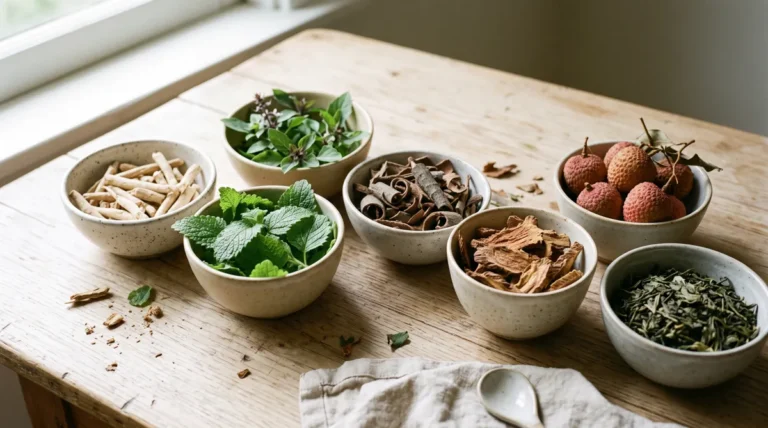

Ashwagandha roots and leaves, the plant behind Sensoril
Sensoril Ashwagandha Cortisol: What 5 Trials Show
Answer first: sensoril ashwagandha cortisol research is real but thin. The best-matched human trial found lower perceived stress at 125 to 500 mg per day over 8 weeks, while a cortisol drop appears in trials of other ashwagandha extracts. CortiSync lists 300 mg of Sensoril per serving. See the official CortiSync page.

Affiliate disclosure: links to CortiSync on this page are affiliate links (code 618161). We may earn a commission at no extra cost to you. This article is educational and is not medical advice. These statements have not been evaluated by the Food and Drug Administration. This product is not intended to diagnose, treat, cure or prevent any disease.
Contents
What Sensoril is and why sensoril ashwagandha cortisol claims need care
Searches for sensoril ashwagandha cortisol return pages that quote big percentages with no study attached. This page does the opposite: it lists the trials we could open and says what each one measured.
Sensoril is a branded ashwagandha extract. A 2026 toxicology paper describes it as an aqueous extract of the roots and leaves of Withania somnifera (PubMed 41987003).
That matters because many ashwagandha trials use root-only extracts. The sensoril ashwagandha cortisol question therefore cannot be answered by quoting any ashwagandha study. Each result belongs to the extract that was tested.
Why sensoril ashwagandha cortisol is not the same as ashwagandha in general
Our earlier comparison, Sensoril vs KSM-66, explains the extract types. Here we focus on trial evidence only.

The five trials behind the sensoril ashwagandha cortisol question
We opened five abstracts through Europe PMC. Two involve a root-and-leaf aqueous extract of the Sensoril type, and three involve other root extracts that did measure cortisol.
| Study | Extract | Sample and length | Dose | What it reported |
|---|---|---|---|---|
| Pandit 2024 (PubMed 38732539) | Aqueous root and leaf extract | 131 adults enrolled, 8 weeks | 125, 250, 500 mg per day | Perceived Stress Scale scores fell; authors cite HPA-axis modulation |
| Ziegenfuss 2018 (PubMed 30463324) | Sensoril | 38 men, 12 weeks | 500 mg per day | Strength training outcomes and blood chemistry |
| Lopresti 2019 (PubMed 31517876) | Shoden root extract | 60 adults, 60 days | 240 mg per day | Lower HAM-A anxiety score and greater morning cortisol reduction |
| Salve 2019 (PubMed 32021735) | High-concentration root extract | 60 adults, 8 weeks | Two different doses | Dose-response stress study |
| Choudhary 2016 (PubMed 27055824) | Root extract | 52 adults, 8 weeks | 300 mg twice daily | Stress-related outcomes in a placebo-controlled trial |
Only the first two rows concern the extract type CortiSync lists. That is why the sensoril ashwagandha cortisol evidence is best described as promising but incomplete.
The 8-week stress trial: Sensoril-type extract and cortisol-linked markers
Sensoril ashwagandha cortisol: what Pandit and colleagues did
Pandit and colleagues ran an 8-week, randomized, double-blind, placebo-controlled study of a root-and-leaf water extract. They compared 125, 250 and 500 mg per day in adults with self-reported high stress (PubMed 38732539).
A total of 131 adults were enrolled. Stress was measured with the 14-item Perceived Stress Scale plus biochemical stress parameters. The trial was registered in India as CTRI/2019/11/022100.
What the authors concluded
The authors report that the extract reduced mild to moderate chronic stress at all three doses, including 125 mg per day, and link this to modulation of the HPA axis. The abstract we opened does not name the brand, so treat the match to Sensoril as a description match.

The 12-week strength trial: the one trial that names Sensoril
Ziegenfuss and colleagues randomized recreationally active men to placebo (19) or 500 mg per day of Sensoril (19) for 12 weeks while following a progressive resistance-training program (PubMed 30463324).
Outcomes were body composition, strength, power, endurance, a cycling time trial and clinical blood chemistries. It was not designed as a cortisol trial, so it cannot confirm a cortisol effect. It is useful mainly as a named-Sensoril dose reference at 500 mg per day.
Sensoril ashwagandha cortisol and toxicology data
The 2026 toxicology report found Sensoril was not mutagenic in the Ames assay and not genotoxic in the other tests described. In rats given 1,000, 2,000 and 4,000 mg per kg per day for 90 days it caused no mortality or test-item-related changes in the parameters listed (PubMed 41987003). Animal data do not prove human safety.

Where cortisol was actually measured in humans
If your question is specifically sensoril ashwagandha cortisol, notice a gap: the trials that report cortisol directly used other extracts.
Lopresti and colleagues gave 60 stressed adults 240 mg per day of the Shoden extract or placebo for 60 days. The extract group had a significant reduction in the HAM-A anxiety scale (P 0.040) and a greater reduction in morning cortisol than placebo (PubMed 31517876). The authors call for larger studies.
Salve and colleagues compared two doses of a high-concentration root extract over 8 weeks in 60 adults (PubMed 32021735). Choudhary and colleagues tested 300 mg twice daily in 52 adults for 8 weeks (PubMed 27055824). A 2021 review also summarizes the stress, anxiety and insomnia literature (PubMed 34254920).
In short, sensoril ashwagandha cortisol is plausible by analogy, but the direct proof comes from different extracts. The same caution applies to our ashwagandha for stress page.
Reading tip: cortisol changes in a trial do not equal a diagnosis or a treatment effect. If you suspect a hormone problem, ask a clinician about testing first.

Label dose vs trial doses
Per the label on the official page (read 2026-10-11), CortiSync lists 300 mg of Sensoril ashwagandha per two-capsule serving, with six other ingredients. This table compares that number with the trial doses above.
| Source | Daily dose | Extract |
|---|---|---|
| CortiSync label (manufacturer) | 300 mg | Sensoril ashwagandha |
| Pandit 2024 | 125, 250 or 500 mg | Root and leaf aqueous extract |
| Ziegenfuss 2018 | 500 mg | Sensoril |
| Lopresti 2019 | 240 mg | Shoden |
| Choudhary 2016 | 600 mg (2 x 300 mg) | Root extract |
The 300 mg label dose falls inside the 125 to 500 mg range used in the stress trial. That is a dose comparison, not proof that the formula works the same way. CortiSync also contains six other ingredients that were not part of these trials.
For the other six ingredients, see our CortiSync ingredients research page, and for timing see CortiSync dosage.

Safety notes for ashwagandha and Sensoril
NCCIH says ashwagandha may be safe for short-term use, but it has been associated with liver injury in rare cases, and little is known about long-term use (see NCCIH ashwagandha below). The NIH Office of Dietary Supplements gives similar cautions.
People who are pregnant, have thyroid or liver conditions, or take sedatives or immunosuppressants should speak to a clinician first. Our who should not take CortiSync page lists the interaction points, and is CortiSync safe covers the safety question.
Claims about Sensoril and cortisol to doubt
Some review pages repeat statements such as a large percentage cortisol drop or a count of human studies with no named trial, journal or author. We could not trace them to a source we opened, so we do not repeat them.
The manufacturer states that CortiSync supports stress and cortisol balance. That is a marketing statement. Our CortiSync reviews and effectiveness page and do cortisol supplements work take a more cautious look.

Who this evidence may fit, and who it does not
It may fit adults with everyday stress who understand that effects in trials were modest, short-term and tested on specific extracts. It may also fit readers who want a Sensoril-containing formula and accept that the finished product is untested.
It does not fit anyone expecting a medical treatment, anyone with a diagnosed adrenal or thyroid disorder without clinician advice, or anyone who is pregnant or nursing. Compare options in CortiSync vs competitors and best supplements to lower cortisol.
If you want to check the current offer, the official CortiSync page shows the manufacturer’s terms. The manufacturer states a 67-day guarantee; confirm it there.
Sensoril ashwagandha cortisol: frequently asked questions
Does Sensoril ashwagandha lower cortisol?
The published sensoril ashwagandha cortisol evidence is limited. A root-and-leaf aqueous extract lowered perceived stress in an 8-week trial of 131 adults, and a different ashwagandha extract lowered morning cortisol in 60 adults. No trial we found tested the CortiSync formula itself.
What dose of Sensoril was used in human trials?
The trials we opened used 125, 250 and 500 mg per day of a root-and-leaf aqueous extract for 8 weeks, and 500 mg per day of Sensoril for 12 weeks in a strength-training study. The CortiSync label lists 300 mg of Sensoril per two-capsule serving.
Is Sensoril the same as KSM-66?
No. Sensoril is described in the literature as an aqueous extract of ashwagandha roots and leaves, while KSM-66 is a root-only extract. Results from one extract should not be assumed for the other. Our comparison page covers the differences in detail.
How long did the Sensoril studies last?
The stress trial lasted 8 weeks and the strength-training trial lasted 12 weeks. The cortisol trials of other extracts ran for 60 days or 8 weeks. None can tell you what happens after several months of use.
Did the studies measure cortisol directly?
Pandit and colleagues reported biochemical stress parameters and HPA-axis modulation, while Lopresti and colleagues reported morning cortisol for a different extract (Shoden). The strength-training Sensoril trial focused on muscle outcomes and clinical blood chemistry, not cortisol.
Is Sensoril safe?
A 2026 toxicology report found no toxicity or genotoxicity signals in standard animal and in vitro tests of Sensoril. Human use is generally short-term in trials. NCCIH notes ashwagandha may be safe for short-term use but has been linked to rare liver injury.
Who should avoid ashwagandha?
NIH sources advise caution in pregnancy, with thyroid conditions, with liver disease and with sedatives or immunosuppressants. Anyone on medication should ask a pharmacist or physician before using a product containing ashwagandha.
Can I rely on the numbers on review pages?
Be careful. Some review pages repeat figures about studies and percentage cortisol drops without naming a trial, journal or author. We could not trace those figures, so this page uses only studies we opened.
What does the manufacturer say about CortiSync?
The manufacturer states that CortiSync is a seven-ingredient formula for stress and cortisol balance and offers a 67-day money-back guarantee on the official page. Check the current terms there before you decide.
Reviewed By
Reviewed for ingredient accuracy and supplement-safety wording by Dr. John Carter, PharmD, clinical pharmacist and lead scientific reviewer at HealthySupplements.us. The review covers the sources and cautions cited here, not a personal recommendation for any reader.
Authority Sources We Opened
- NCCIH: Ashwagandha
- NIH ODS: Ashwagandha (health professional)
- NIH ODS: Ashwagandha (consumer)
- LiverTox: Ashwagandha
- NCCIH: Using dietary supplements wisely
- NIMH: Stress
- PubMed 38732539: Pandit 2024, Nutrients
- PubMed 30463324: Ziegenfuss 2018, STAR trial
- PubMed 41987003: Summan 2026, Sensoril safety evaluation
- PubMed 31517876: Lopresti 2019, Medicine
- PubMed 32021735: Salve 2019, Cureus
- PubMed 27055824: Choudhary 2016
- PubMed 34254920: Speers 2021 review