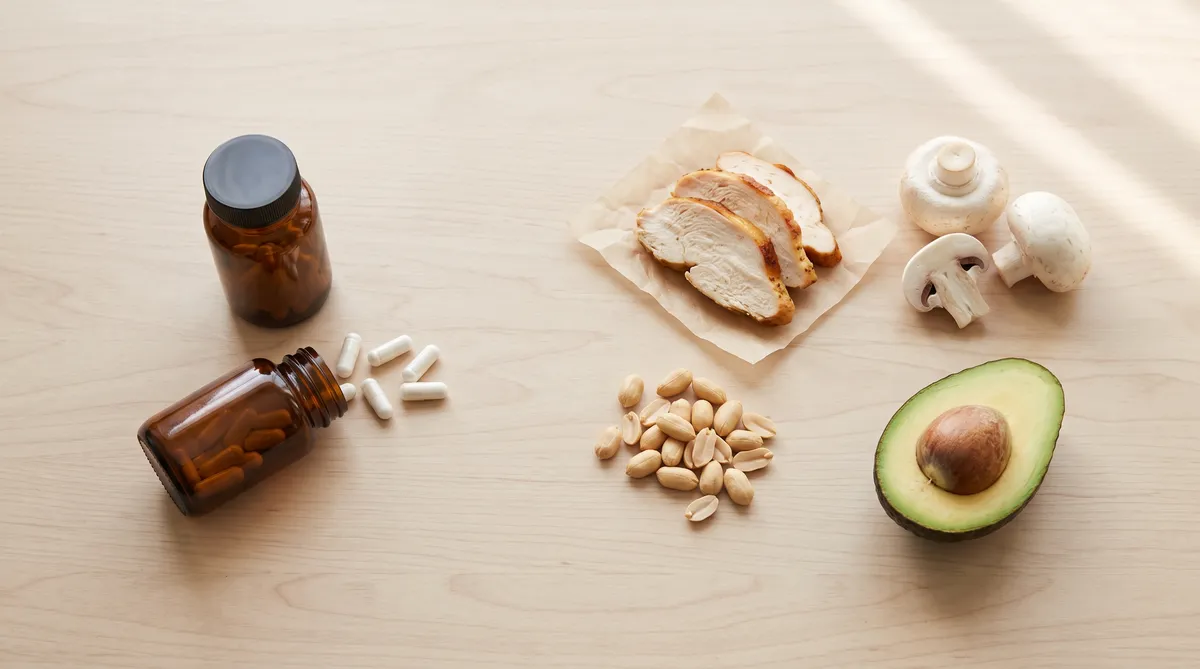
Vitamin B3 comes from food and from supplements; NMN and niacinamide are two different routes.
This article is part of our NMN & NAD+: The Complete Guide.
Answer first: NMN vs niacinamide comes down to purpose. Niacinamide is a common vitamin B3 form with an official upper limit, while NMN is a newer NAD+ precursor that human trials dosed at 250 mg a day. If you want the NMN route, GenuinePurity NMN is the option we recommend.
Affiliate disclosure: links to GenuinePurity on this page are affiliate links (code 618161). We may earn a commission at no extra cost to you. This page is educational and does not diagnose, treat, cure or prevent any disease.
Table of Contents
Searching NMN vs niacinamide usually means one question: which one actually helps the body make NAD+, and which is worth paying for? Both feed the same pathway, but they are not the same molecule, dose or purchase.
In short, NMN vs niacinamide is a question of purpose, evidence and cost, not of one winner. Below are seven differences, built from NIH fact sheets and study abstracts we opened. For the wider picture of NAD+ and NMN, start with our NMN and NAD+ guide.
NMN vs niacinamide, difference 1: what each one is
Niacin is the umbrella name for vitamin B3. The NIH Office of Dietary Supplements niacin fact sheet for professionals says nicotinic acid and nicotinamide are the two most common forms in supplements. Niacinamide is simply another name for nicotinamide.
NMN, short for nicotinamide mononucleotide, is nicotinamide joined to a ribose-phosphate group. The body treats it as a building block for NAD+, a molecule the NIH says more than 400 enzymes need to do their work. Our guide on whether NMN is the same as NAD untangles the names.
| Point | Niacinamide (nicotinamide) | NMN |
|---|---|---|
| What it is | A vitamin B3 form | An NAD+ precursor, nicotinamide plus ribose-phosphate |
| Official intake guidance | RDA 16 mg NE for men and 14 mg NE for women (all niacin forms); upper limit 35 mg a day from supplements | Not covered by the NIH niacin fact sheet; no official intake level in the sources we opened |
| Skin flushing | Not caused by nicotinamide, per the NIH | Not reported as a main issue in the trials we read; long-term data is limited |
| Dose seen in the sources | 500 mg a day or more can cause diarrhea and easy bruising (NIH) | 250 mg a day for 6 to 12 weeks in older-men and older-adult trials |
| Where to get it | Food and ordinary vitamin products | Supplements such as GenuinePurity NMN |
NMN vs niacinamide, difference 2: where each sits on the NAD+ route
In the textbook salvage pathway, nicotinamide is converted to NMN, and NMN is converted to NAD+. So niacinamide sits one step earlier than NMN. Our NMN salvage pathway explainer walks through each step.
That order is why people assume skipping a step must be better. The evidence is less tidy. A 2016 study in mice and humans found that nicotinamide riboside, a close cousin of NMN, had distinct and superior pharmacokinetics to nicotinic acid and nicotinamide in mouse liver, and raised human blood NAD+ in a dose-dependent way at 100, 300 and 1,000 mg.
That study tested NR, not NMN, and not niacinamide in people. Read it as a hint that the form matters, not as proof that NMN beats niacinamide.
NMN vs niacinamide, difference 3: what human trials tested
For NMN, a placebo-controlled trial gave 250 mg of NMN a day to older men for 6 or 12 weeks. Blood NAD+ metabolites rose, the capsules were well tolerated, and the authors reported changes in muscle function. A separate 12-week trial in Japanese older adults also used 250 mg.
A 2025 meta-analysis pooled 12 randomized trials with 513 participants. NMN raised blood NAD+ overall, but most clinically relevant outcomes, such as glucose and blood fats, were not significantly different from control. Seven studies had some bias concerns and five had high risk of bias, and the authors warned the benefits may be exaggerated.
For niacinamide as a NAD+ booster in the NMN vs niacinamide debate, we did not find a comparable trial in the sources we opened. We also found no direct NMN-versus-niacinamide trial. Every “X raises NAD+ more than Y” claim online is therefore an inference. Our NMN clinical evidence ranking shows how we weigh these studies.
See the official GenuinePurity NMN page
NMN vs niacinamide, difference 4: the gut conversion twist
A 2025 mouse study found that only a small portion of orally given NMN and NR was absorbed directly from the small intestine. Most was deaminated by gut microbes into nicotinic acid before the body used it for NAD+.
If that holds in people, the line between NMN and a niacin form is blurrier than marketing suggests. It is a mouse result, so we do not claim it for humans. It is also a reason to choose NMN for its trial history and quality paperwork rather than for a “skip the queue” story. Our piece on taking NR and NMN together makes the same point.
NMN vs niacinamide, difference 5: safety limits and side effects
Safety is where niacinamide has the clearer paper trail in the NMN vs niacinamide comparison. The NIH niacin fact sheet for consumers lists a supplemental upper limit of 35 mg a day for adults. It says nicotinamide does not cause skin flushing, while 30 mg or more of nicotinic acid can.
The same NIH sheet reports that nicotinamide at 500 mg a day or more may cause diarrhea and easy bruising, and that 3,000 mg a day may cause nausea, vomiting and liver damage. People on tuberculosis drugs or diabetes medicines should speak to a clinician about niacin forms.
NMN has no NIH fact sheet. Trials at 250 mg a day reported it was well tolerated, but they were short and small, so long-term safety remains open. Our guide to why people stop taking NMN lists the complaints users report.
NMN vs niacinamide, difference 6: the sirtuin question
A well-known 2002 laboratory paper showed that nicotinamide inhibits yeast Sir2 and human SIRT1 in lab systems. That is why some forum posts warn that high-dose niacinamide could work against sirtuins.
The paper does not show that happens in people at supplement doses, and we found no human trial that settles it. We mention it because it is the most common objection in NMN vs niacinamide threads, and because it is another reason to keep niacinamide within published limits.
NMN vs niacinamide, difference 7: cost, access and legal status
On cost, NMN vs niacinamide is not a like-for-like price comparison. Niacinamide is sold as an ordinary vitamin, and we did not compare retailer prices here. NMN is a specialty supplement. On its official page, read on October 20, 2026, the manufacturer states each capsule has 250 mg of NMN at 96% purity, with one capsule daily taken with meals.
| GenuinePurity NMN option (manufacturer page, read 2026-10-20) | Price shown | Our math for 60 capsules at 1 a day |
|---|---|---|
| 1 bottle | $69 | about $1.15 a day |
| 3 bottles | $65 each | about $1.08 a day |
| 6 bottles | $59 each | about $0.98 a day |
| Subscription | $49 each | about $0.82 a day |
The page also states a 97-day money-back guarantee (it mentions 90 days in places), free shipping on orders of $89 or more, and links two certificates of analysis. We could not verify the page’s FDA-inspection wording, so use the lab reports, not the slogan, as your test. Our NMN purity testing guide and GenuinePurity legitimacy check show how.
On legal status, the FDA said in letters dated September 29, 2025, that NMN is not excluded from the dietary supplement definition. Sellers generally still need a new dietary ingredient notification, and the position could change. The trade group NPA describes the same history.
Can you take NMN and niacinamide together? The NMN vs niacinamide stacking question
We found no trial of the combination, so there is no tested dose. Two products feeding one pathway is not automatically better, and niacin forms have an upper limit. If you are weighing it, compare the totals against the NIH 35 mg limit and ask a pharmacist.
Curious about stacking in general? Read our NMN vs NR comparison and our NMN questions hub.
Who should pick which in NMN vs niacinamide
| If this describes you | Sensible next step |
|---|---|
| You want to meet vitamin B3 needs, or a clinician suggested niacinamide | Follow your clinician and the NIH limits; food and a standard vitamin cover most needs |
| You are curious about NAD+ precursors and accept that human evidence is early | Consider NMN at the dose trials used, from a seller that shows lab reports, such as GenuinePurity NMN |
| You are pregnant, nursing, on medicines or have liver or kidney disease | Talk to a doctor before either one |
| You mainly want skin results | Ask a dermatologist; creams are a different product |
Safety first
Whichever side of NMN vs niacinamide you lean toward, tell your doctor or pharmacist about every supplement you take. The NCCIH advice on using supplements wisely warns that labels do not always match contents and that supplements can interact with medicines. The FDA generally cannot approve supplements before they are sold.
Check GenuinePurity NMN pricing and guarantee
NMN vs niacinamide: frequently asked questions
In NMN vs niacinamide, is NMN better?
In NMN vs niacinamide there is no head-to-head human trial in the sources we opened, so no one can call either better on evidence alone. They do different jobs: niacinamide is a vitamin B3 form with an official intake range, while NMN is an NAD+ precursor that trials dosed at 250 mg a day.
Can you take NMN and niacinamide together?
We found no trial testing the pair, so there is no evidence-based combined dose. Both feed the same NAD+ pathway, so doubling up is guesswork. Keep any niacin form under the 35 mg supplemental upper limit unless a doctor directs otherwise, and tell your pharmacist about both.
Is NMN a form of niacinamide?
No. Niacinamide is the same molecule as nicotinamide, a vitamin B3 form. NMN is nicotinamide joined to a ribose-phosphate group. In the body nicotinamide can be turned into NMN and then into NAD+, which is why they are often compared.
Does niacinamide raise NAD+ like NMN does?
The human trials we opened tested NMN and NR, not niacinamide, so we cannot quote how much niacinamide raises blood NAD+. NMN at 250 mg a day raised blood NAD+ in older men over 6 or 12 weeks, and a 2025 review of 12 trials agreed.
Does niacinamide cause flushing?
The NIH says nicotinamide does not cause skin flushing, while nicotinic acid typically does at 30 to 50 mg or more. That is the main practical difference between the two common niacin supplement forms, and it is why many people choose niacinamide.
How much niacinamide is too much?
The NIH upper limit for adults is 35 mg a day of niacin from supplements. The NIH also reports that nicotinamide at 500 mg a day or more may cause diarrhea and easy bruising, and 3,000 mg a day may cause nausea, vomiting and liver damage. Higher doses belong under medical supervision.
What NMN dose have trials used?
The older-men trial we read gave 250 mg a day for 6 or 12 weeks in a placebo-controlled design. Another 12-week trial in older adults also used 250 mg. A larger bottle strength is not proof of a better result.
Does NMN turn into niacin in the gut?
In mice, a 2025 study found that only a small portion of oral NMN was absorbed directly, and most was converted by gut microbes to nicotinic acid. Human gut handling has not been shown the same way, so treat it as a lead, not a verdict.
Is NMN legal to sell as a supplement?
On September 29, 2025, the FDA said NMN is not excluded from the dietary supplement definition. Sellers still generally need a new dietary ingredient notification, and the FDA position could change. Check that a brand names its notification and lab reports.
Is skincare niacinamide the same as the supplement?
The molecule is the same, but a cream applied to skin is a different product, dose and purpose from a capsule you swallow. This guide covers oral supplements only. Ask a dermatologist about topical products, which sit outside the NMN vs niacinamide supplement question.
Reviewed by: Dr. John Carter, PharmD, clinical pharmacist and lead scientific reviewer focused on supplement safety and drug-supplement interactions.
About the author: Dr Sarah Mitchell, MD, is the Chief Medical Officer of Healthy Supplements, with a focus on women’s health and hormonal balance (read her profile). Safety review for this page: Dr. John Carter, PharmD.
Sources behind this NMN vs niacinamide guide
- NIH ODS: Niacin fact sheet for health professionals
- NIH ODS: Niacin fact sheet for consumers
- MedlinePlus: Niacin (vitamin B3)
- NCCIH: Using dietary supplements wisely
- FDA: Dietary supplements
- Venable: FDA position on NMN (September 29, 2025 letters)
- Natural Products Association: FDA and NMN update
- PubMed: Trammell 2016, nicotinamide riboside bioavailability
- PubMed: Bitterman 2002, nicotinamide and sirtuins in the lab
- PubMed: Igarashi 2022, NMN in older men
- PubMed: 2025 meta-analysis of oral NMN trials
- PubMed: Yaku 2025, gut microbiota and NMN or NR
- GenuinePurity NMN official page (read 2026-10-20)