This article is part of our Male Fertility: The Complete Guide.
By Healthy Supplements Editorial Team · Sources opened and product page read on 4 November 2026
DIM vs I3C in short: Indole-3-carbinol (I3C) is the compound that forms when glucobrassicin in cruciferous vegetables such as broccoli and cabbage is broken down. Diindolylmethane (DIM) is what much of that I3C becomes after it meets stomach acid. In a phase I trial, I3C itself was not detectable in blood and DIM was the only I3C-derived product found, so DIM vs I3C is less a fight between two strangers than a choice between a starting material and one of its end products. No head-to-head human trial was found in the sources opened for this page, which means nobody can honestly name a winner. If you decide you want DIM itself, the manufacturer states that DIM3X provides 200 mg of DIM, one capsule daily with meals.
Affiliate disclosure: some links on this page are affiliate links; if you buy through them we may earn a commission at no extra cost to you. Medical note: this page is information, not medical advice. These statements have not been evaluated by the Food and Drug Administration, and dietary supplements are not intended to diagnose, treat, cure or prevent any disease.
Search for DIM vs I3C and you will find a lot of confident answers, most of them from people selling one of the two. This page does something different: it reads what the studies and the cancer-center monographs actually say, separates lab findings from human data, and tells you where the gap is. If you are new to the compound, start with our explainer What Is DIM (Diindolylmethane)? and our broader men’s health guide, then come back here for the DIM vs I3C comparison.
DIM vs I3C: the short answer
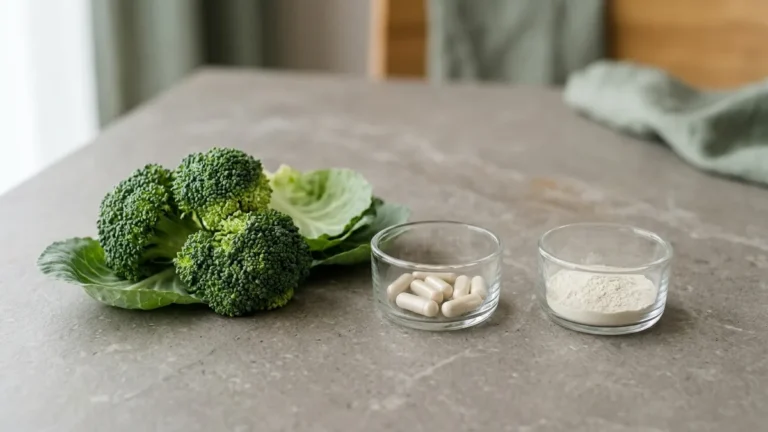
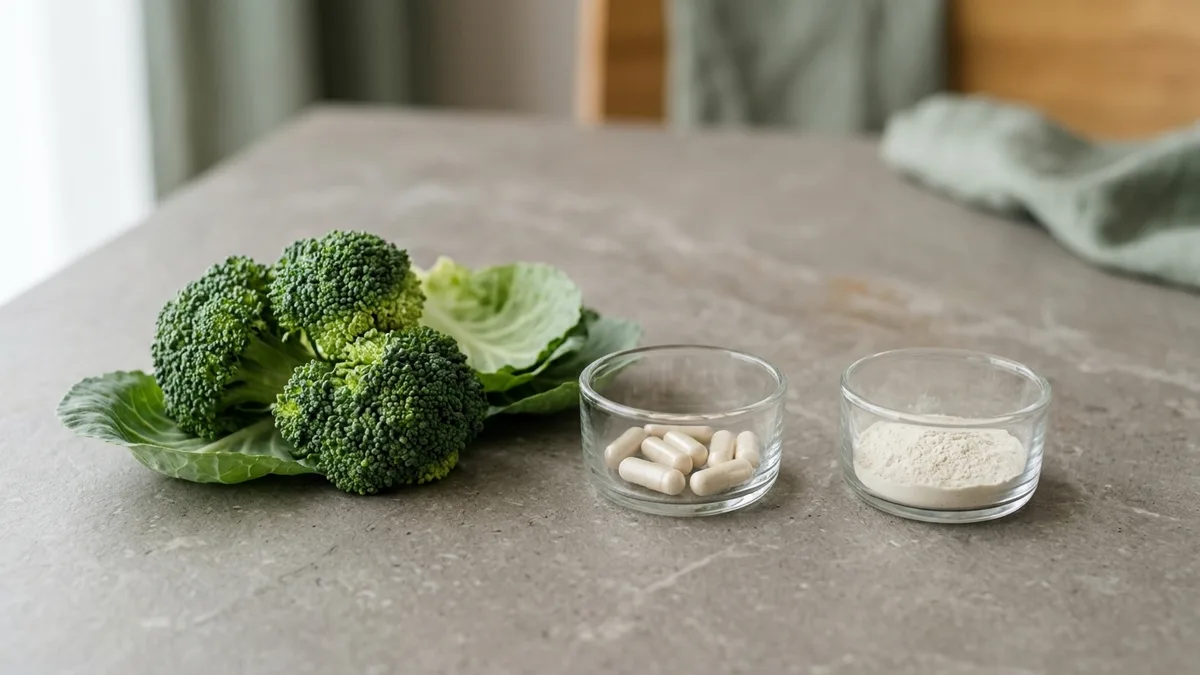
The short answer to DIM vs I3C is that they are chemically linked. Memorial Sloan Kettering describes DIM as a metabolite of I3C and as the most studied of the I3C metabolites (MSK, DIM page, updated 15 December 2023). The same cancer center describes I3C as a compound formed when the body breaks down glucobrassicin, which is found in broccoli, cabbage, cauliflower, Brussels sprouts and kale (MSK, I3C page, updated 2 August 2023). So when people ask about DIM vs I3C, they are really asking whether it is better to swallow the parent compound or the product it turns into.
Here is the honest framing. For DIM vs I3C, the human evidence is thin on both sides. The studies are small, many were designed to test safety and blood levels rather than results you would feel, and most enrolled women. Anyone who tells you one is proven to beat the other is selling something. What you can do is understand how the two relate, what was actually tested, and what the cautions are, which is what the rest of this page covers.
How I3C turns into DIM in your body
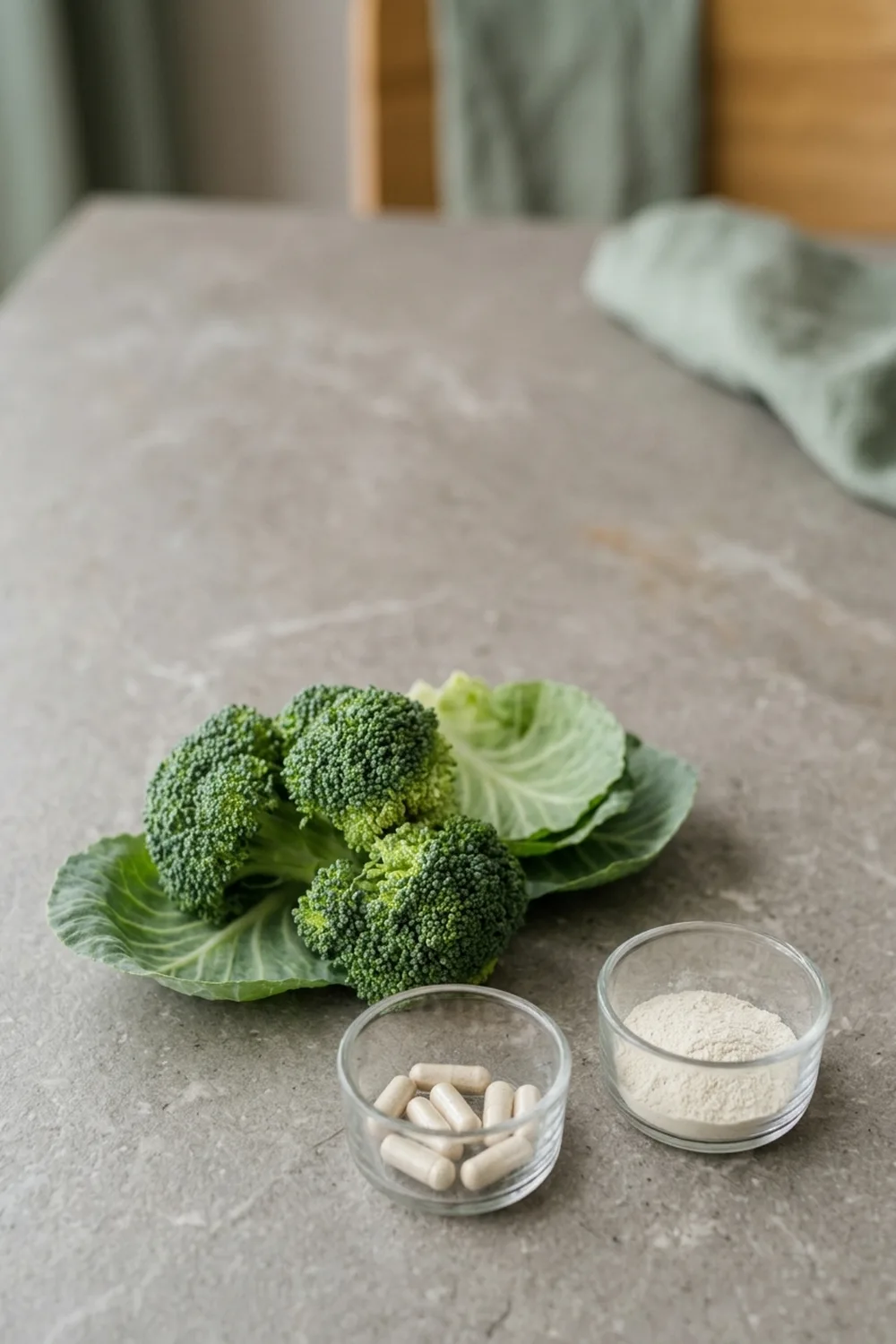
This is the heart of DIM vs I3C. Oregon State University’s Linus Pauling Institute explains that in the acidic stomach, I3C undergoes acid-catalyzed condensation, producing DIM along with other compounds (indolo[3,2-b]carbazole and a cyclic trimer). It also reports that after single oral doses of I3C in women, no I3C was detected in plasma, and DIM peaked at about two hours (Linus Pauling Institute, most recent listed review July 2017).
That matches the original study. In a phase I trial, women received oral I3C at 400, 600, 800, 1,000 and 1,200 mg. I3C itself was not detectable in plasma, and the only I3C-derived product detected was DIM. Mean peak DIM rose from 61 ng/mL after 400 mg to 607 ng/mL after 1,000 mg, with no further rise at 1,200 mg, and the authors noted large differences between individuals (Cancer Epidemiol Biomarkers Prev 2006, PMID 17164373). In plain language: two women taking the same I3C dose could end up with quite different DIM levels, which is one reason people ask about DIM vs I3C in the first place.
One practical wrinkle from the Linus Pauling Institute page: acid-suppressing drugs such as antacids, H2 blockers and proton-pump inhibitors would likely prevent DIM from forming from I3C in the stomach. A DIM capsule skips that step, which is a real, mechanical difference in the DIM vs I3C choice, although the page also says it is unknown whether the loss of DIM changes I3C’s other effects.
What human studies tested in DIM vs I3C research
Because DIM vs I3C has no head-to-head trial, the useful move is to line up what each compound was actually tested for. Here are the four human studies opened for this page, each read from its abstract.
| Study | Who and what | What the abstract reports |
|---|---|---|
| I3C single-dose study (2006) | Women; 400 to 1,200 mg I3C | I3C not detectable; DIM the only I3C-derived product found; DIM peak rose to 607 ng/mL at 1,000 mg then plateaued |
| I3C phase I trial (2005) | 17 women from a high-risk breast cancer cohort; 400 mg daily for 4 weeks, then 800 mg daily for 4 weeks | Doses well tolerated; CYP1A2 activity raised in 94% of subjects at 800 mg; urinary 2/16 hydroxyestrone ratio up 66%, maximal at 400 mg with no further increase at 800 mg; serum estradiol, progesterone, LH, FSH and SHBG unchanged |
| DIM single-dose study (2008) | Healthy men and women; absorption-enhanced DIM at 50, 100, 150, 200 and 300 mg | No DIM-related adverse effects up to 200 mg; at 300 mg one of six reported mild nausea and headache and one also reported vomiting, judged probably related |
| DIM plus tamoxifen trial (2017) | 130 women prescribed tamoxifen; DIM 150 mg twice daily or placebo for 12 months | 98 completed; compliance 91%; DIM raised the urinary 2/16 hydroxyestrone ratio and favorably shifted estrogen metabolism and SHBG; authors flagged lower tamoxifen metabolites, including a possible effect on endoxifen, as needing research |
Sources: PMID 17164373, PMID 16103443, PMID 18843002 and PMID 28560655. Two things stand out in this DIM vs I3C evidence. First, the biomarker used most often is the urinary 2/16 hydroxyestrone ratio, which is a lab marker, not a symptom or a clinical outcome. Second, the tamoxifen trial is a reminder that a compound that changes estrogen metabolism can also interact with a medicine that depends on it.
The Linus Pauling Institute also reports negative results that matter for the DIM vs I3C conversation: DIM at 2 mg/kg/day for 12 weeks in 64 women with cervical precancer showed no benefit, and a six-month trial of DIM at 150 mg/day in 551 women did not promote HPV clearance or prevent progression. The Institute also reports a small I3C trial in which complete regression occurred in 4 of 8 women at 200 mg/day and 4 of 9 at 400 mg/day, versus 0 of 10 on placebo. The National Cancer Institute’s cruciferous vegetable fact sheet (reviewed June 2012, so read it as history) describes one 2000 trial in which I3C was more effective than placebo for abnormal cervical cells, and says human results overall are mixed (NCI fact sheet). None of this tells you what either compound does for a man taking a capsule at home, and we will not pretend it does.
DIM vs I3C side by side
| Question | I3C | DIM |
|---|---|---|
| What it is | Parent compound formed from glucobrassicin in cruciferous vegetables | Metabolite of I3C; the most studied I3C metabolite (MSK) |
| What happens after swallowing | Condenses in stomach acid; I3C itself not detected in plasma in the 2006 study | Capsule supplies DIM directly; absorption-enhanced forms were used in the studies above |
| Doses in human studies read here | 400 to 1,200 mg single dose; 400 and 800 mg daily; supplement range of 200 to 800 mg/day per the Linus Pauling Institute | 50 to 300 mg single dose; 150 mg twice daily for 12 months in the tamoxifen trial |
| Reported adverse effects | Skin rash; rare small ALT increases (MSK); disequilibrium and tremor at 800 mg/day that resolved on lowering the dose (LPI) | Mild nausea, headache, vomiting at 300 mg single dose; case reports of eye, rash, stroke and clot events with causation not established (MSK) |
| Drug-enzyme concern | May induce CYP1A2; MSK lists CYP1A2 substrate drugs under do-not-take | May alter CYP450 and MDR1 substrate drugs; lower endoxifen in one tamoxifen study (MSK) |
| Pregnancy | Safety not established (LPI) | MSK says pregnant, planning or nursing women should not take it |
| Men | No man-specific trial in sources read | Included men only in the single-dose safety study |
If you read only one row of this DIM vs I3C table, make it the last one. The estrogen-metabolite findings come from women, and our own DIM supplement for men page already explains why that gap matters before a man draws conclusions.
Safety in the DIM vs I3C debate: where the cautions overlap
A fair DIM vs I3C comparison has to put safety next to the biochemistry. Memorial Sloan Kettering lists DIM adverse reactions as case reports: central serous chorioretinopathy in a healthy woman after excessive daily intake for two months (resolved eight weeks after stopping), a rash with eosinophilia and systemic symptoms, an ischemic stroke in a 38-year-old woman using a DIM supplement, and a pulmonary embolism with deep vein thrombosis in a 65-year-old man using DIM. Case reports cannot prove cause, and we are not claiming they do. They do show why “natural” is not a safety guarantee, a point the NIH makes plainly in its guidance on using supplements wisely (NCCIH).
For I3C, MSK lists skin rash and rare small increases in ALT, and says it is generally well tolerated orally. Its page also notes that some animal studies suggest I3C may promote tumor growth, and the Linus Pauling Institute reports that in animals chronic I3C after a carcinogen enhanced cancer while I3C before or with it inhibited tumors. The Institute adds that several experts caution against widespread human use until risks and benefits are better understood. Seen that way, the DIM vs I3C safety picture is not “one is safe and one is dangerous”; it is “both are under-studied, and both touch drug-processing enzymes.”
The NIH Office of Dietary Supplements adds general guardrails that apply to either choice: side effects are most likely at high doses or when several supplements are combined, some products can change how medicines work, and pregnant or nursing people should be cautious (ODS fact sheet). The FDA explains that companies, not the agency, are responsible for checking supplement safety and labeling before sale, and that the FDA can generally act only after a product is on the market (FDA dietary supplements page).
See the DIM3X page (manufacturer details)
Who should not take either one without asking first
Based on the MSK and Linus Pauling Institute pages, these are the groups where DIM vs I3C stops being a shopping question and becomes a clinician question:
- Pregnant, planning to conceive or nursing: MSK says DIM should not be taken, and the Linus Pauling Institute says I3C safety in pregnancy and lactation has not been established.
- People taking tamoxifen: one study found significantly lower serum endoxifen with DIM, and the 2017 trial authors asked for research on whether that lowers tamoxifen benefit.
- People taking medicines processed by CYP450, CYP1A2 or MDR1: MSK says DIM may make CYP450 and MDR1 substrate drugs less effective, and lists CYP1A2 substrate drugs under do-not-take for I3C.
- People using birth-control pills: MSK advises asking a healthcare professional first.
- People on acid-suppressing drugs: relevant mainly if you were considering I3C, because the Linus Pauling Institute says these would likely prevent DIM formation from it.
- Anyone with a hormone-sensitive condition, liver concerns, or an upcoming surgery: tell your clinician about every supplement, as the NIH advises.
What the DIM3X page states (read 4 November 2026)
Because many readers searching DIM vs I3C are really comparing a specific product, here is what the manufacturer states on the official DIM3X page. These are the company’s statements, not our testing. It states that the formula is “clinically dosed with 200 mg” of DIM, taken as one capsule daily with meals, and names vitamin E (134% of the daily value), AstraGin and BioPerine without giving amounts for them. It offers a 67-day money-back guarantee, with the refund minus shipping, and the page is inconsistent about whether you return the unused portion or the empty bottles. No price is shown on the page text I read, and it carries the standard FDA disclaimer.
Two things the page does not do, and we want you to notice them. It never mentions I3C, so it cannot answer the DIM vs I3C question for you. And it lists no pregnancy, medication or who-should-avoid warnings, which is why the cautions above matter. The page also says there are no reported negative side effects; we do not repeat that, because the MSK case reports and the 300 mg single-dose results above show that DIM can cause reactions in some people. For the full question list, see our DIM3X questions page and the DIM 3X bonus bottle explainer.
On dose: the single-dose study tested absorption-enhanced DIM up to 300 mg and reported no DIM-related adverse effects up to 200 mg. We are not saying that DIM3X is the same formulation, or that 200 mg is right for you; the study used a specific absorption-enhanced product, and the page does not say whether DIM3X is the same. What it does show is that the 200 mg figure sits inside the range researchers have actually studied, which is more than many supplement pages can say.
How to choose between DIM vs I3C: a practical checklist
- Decide what you actually want. If your goal is the DIM molecule, a DIM product delivers it directly; I3C delivers a mixture that depends on your stomach acid.
- Check your medicines first. Anything processed by CYP450, CYP1A2 or MDR1, tamoxifen, birth-control pills, or acid-suppressing drugs changes the DIM vs I3C answer.
- Read the Supplement Facts panel. Look for the amount of DIM or I3C per capsule, not just a blend name, and compare it to the doses in the table above.
- Ask about testing. The ODS notes that independent seals from organizations such as NSF International or USP exist, but they do not guarantee a product is safe or effective.
- Start by asking, not by buying. Tell your clinician you are weighing DIM vs I3C, bring the product label, and let them check it against your history.
- Stop and call a clinician if you have side effects, as NCCIH advises, especially vision changes, rash, severe headache, or leg swelling and chest symptoms.
For men looking at hormone-related topics more broadly, our guide to cortisol in men over 40 explains why stress hormones belong in the same conversation, and CortiSync vs DIM3X compares two very different approaches. Those are separate questions from DIM vs I3C, but they often come up in the same search.
The verdict on DIM vs I3C
Verdict: in the DIM vs I3C comparison, DIM is the better-defined, more direct choice if you want that specific molecule, because I3C turns into DIM in stomach acid and varies between individuals. I3C is not a worse idea by default, and the studies read here do not prove DIM beats it. What they do show is that both have limited human data, both interact with drug-processing enzymes, and neither belongs in pregnancy. If you have decided on DIM, the manufacturer states that DIM3X provides 200 mg per daily capsule with a 67-day guarantee, and you should still run it past your clinician first.
Check DIM3X details and the 67-day guarantee
DIM vs I3C FAQ
What is the difference between DIM and I3C?
I3C (indole-3-carbinol) forms when glucobrassicin in cruciferous vegetables is broken down. DIM (diindolylmethane) is a metabolite of I3C and the most studied one, according to Memorial Sloan Kettering. In the DIM vs I3C question, one is the starting compound and the other is what much of it becomes after stomach acid.
Does I3C turn into DIM in the body?
Largely, yes. In a phase I trial in women given 400 to 1,200 mg of I3C, I3C itself was not detectable in plasma and the only I3C-derived product detected was DIM. Oregon State University describes acid-catalyzed condensation in the stomach that produces DIM and other compounds.
Is DIM better than I3C?
No head-to-head human trial comparing them was found in the sources opened for this page, so no honest source can call a winner. MSK says DIM is thought to be better than I3C at chemoprotection against breast and prostate cancers, but adds that clinical data are limited. Treat DIM vs I3C as an open question.
Which is safer, DIM vs I3C?
Both have limited human safety data. I3C has reported skin rash and rare small ALT (liver enzyme) increases; DIM has case reports of eye, rash, stroke and clot events where causation was not established. Neither should be used in pregnancy, and both can affect drug-metabolizing enzymes.
What doses were used in DIM vs I3C studies?
I3C was tested at 400 to 1,200 mg in a single-dose study and at 400 mg then 800 mg daily in a four-week phase I trial. An absorption-enhanced DIM was tested at 50 to 300 mg single doses, and at 150 mg twice daily for 12 months in women taking tamoxifen. These are study doses, not recommendations.
Can I take DIM or I3C with tamoxifen or other medicines?
Ask a clinician first. MSK reports that one clinical study found significantly lower serum endoxifen (the active tamoxifen metabolite) with DIM, and that DIM may alter CYP450 and MDR1 substrate drugs. I3C may induce CYP1A2, which matters for CYP1A2 substrate drugs.
Is there evidence for DIM vs I3C in men?
Not in the sources read here. The I3C trials enrolled women, the tamoxifen trial enrolled women, and the single-dose DIM study enrolled healthy men and women. Men should not assume the estrogen-metabolite findings in women apply to them.
Can I get I3C or DIM from food?
Cruciferous vegetables such as broccoli, cabbage, cauliflower, Brussels sprouts and kale contain the glucobrassicin that forms I3C. The National Cancer Institute notes that human studies of these vegetables show mixed results, and a vegetable page cannot tell you what a capsule does.
What does DIM3X state on its label page?
The manufacturer states 200 mg of DIM, 1 capsule daily with meals, vitamin E at 134% of the daily value, AstraGin and BioPerine, and a 67-day money-back guarantee (page read on 4 November 2026). The page does not mention I3C and lists no medication or pregnancy warnings, so those questions go to your clinician.
Sources opened for this DIM vs I3C page
- Memorial Sloan Kettering: Diindolylmethane (updated 15 December 2023)
- Memorial Sloan Kettering: Indole-3-carbinol (updated 2 August 2023)
- Oregon State University Linus Pauling Institute: Indole-3-Carbinol
- National Cancer Institute: Cruciferous Vegetables and Cancer Prevention
- Europe PMC: I3C single and multiple dose pharmacokinetics (PMID 17164373)
- Europe PMC: phase I study of I3C in women (PMID 16103443)
- Europe PMC: single-dose DIM pharmacokinetics and tolerability (PMID 18843002)
- Europe PMC: DIM trial in patients taking tamoxifen (PMID 28560655)
- NCCIH: Using Dietary Supplements Wisely
- NIH Office of Dietary Supplements: What You Need to Know
- FDA: Dietary Supplements
- Manufacturer page (affiliate link): DIM3X official page, read 4 November 2026
More from us: what is DIM, DIM supplement for men, DIM3X questions, tracking a male fertility supplement.