

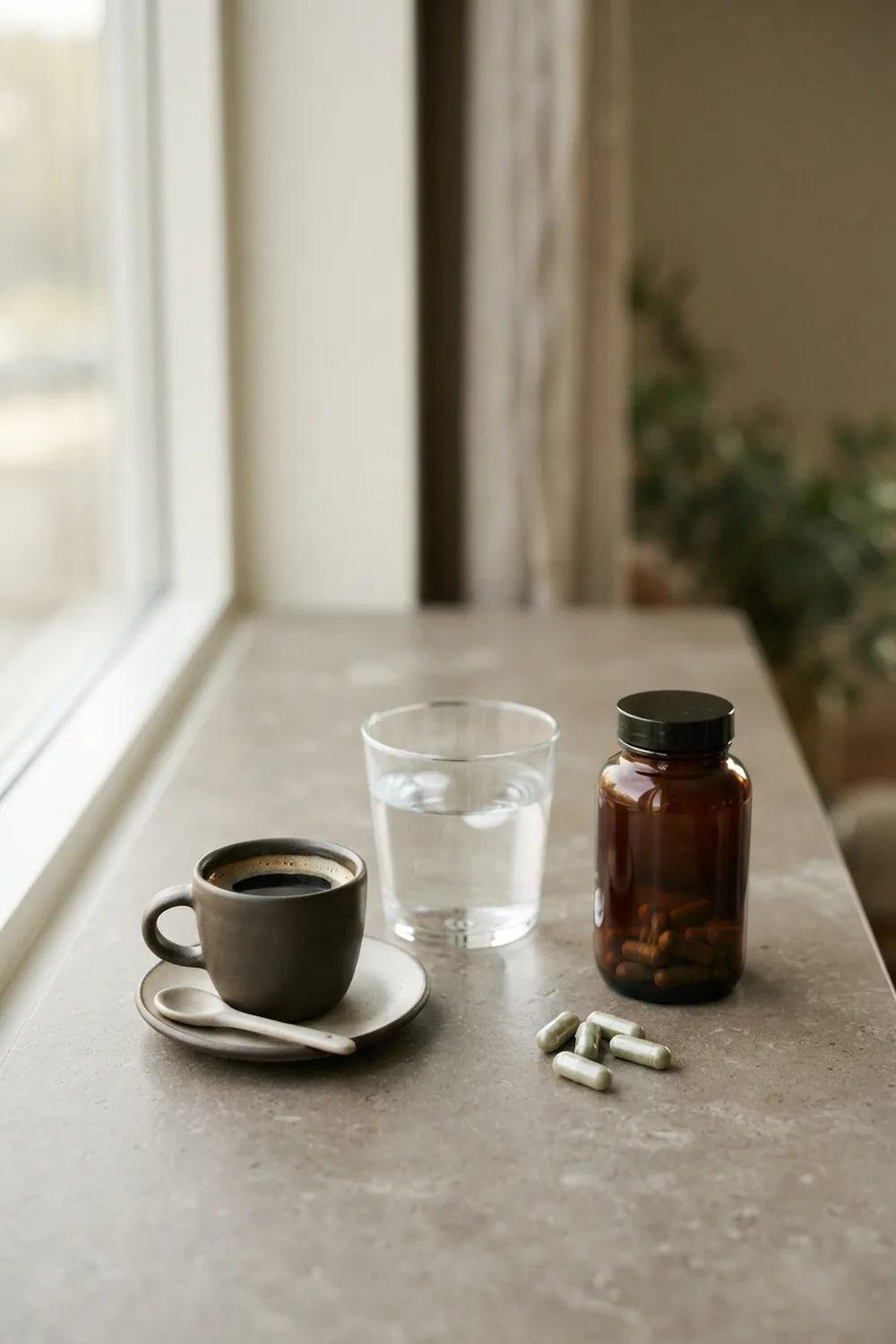
Caffeine and male fertility: coffee, water and a supplement bottle.
This article is part of our Male Fertility: The Complete Guide.
Short answer: on caffeine and male fertility, the research is mixed. A 2017 systematic review of 19,967 men found that semen parameters did not seem affected by caffeine from coffee, tea and cocoa in most studies, while cola and caffeine-containing soft drinks were linked to lower semen volume, count and concentration in other work. A separate 2017 clinic study found no link with semen quality but a lower live birth rate after assisted reproduction in the highest caffeine group. None of that proves caffeine is the cause. The Fertility Factor 5 official page lists five ingredients, none of them caffeine (page read 16 November 2026).
By Healthy Supplements Editorial Team | Sources read 16 November 2026
Caffeine and male fertility is a question that comes up the moment a man books a semen analysis. Should the morning coffee go? What about the pre-workout, the cola at lunch or the energy drink at 3 pm? The honest answer from the papers I opened is that the evidence is inconsistent, and the signal is stronger for cola than for coffee.
This page answers caffeine and male fertility using only sources I opened on 16 November 2026: three study abstracts plus pages from the FDA, Mayo Clinic, MedlinePlus, the NHS, NICHD, the CDC and the NIH. It is an information guide, not medical advice, and it does not promise that cutting back or taking any product changes your results. For the wider picture, start with our male fertility guide and our review of whether male fertility supplements work.
Caffeine and Male Fertility: What the Studies Found
Three papers carry most of the weight on caffeine and male fertility, and they ask different questions. One counted sperm in young Danish men, one pooled the whole field in a review, and one followed men inside a fertility clinic. Here is what each abstract says.
| Source | Who was studied | What it reported |
|---|---|---|
| 2017 systematic review, Nutrition Journal (PMID 28646871) | Observational studies including 19,967 men in total | Semen parameters did not seem affected by caffeine from coffee, tea and cocoa drinks in most studies; other work pointed to a negative effect of cola and caffeine-containing soft drinks on semen volume, count and concentration. Evidence on sperm DNA and time to pregnancy was mixed. The authors called the evidence inconsistent and inconclusive. |
| 2010 American Journal of Epidemiology study (PMID 20338976) | 2,554 young Danish men examined for military fitness in 2001 to 2005 | Moderate caffeine and cola intake went with lower sperm concentration and total sperm count, but only the cola result was significant. The authors could not attribute it to caffeine and noted a less healthy lifestyle might explain it. |
| 2017 Andrology study (PMID 28187518) | 171 men from subfertile couples: 338 semen analyses and 205 assisted reproductive technology cycles | No association between caffeine intake and semen quality. Higher male caffeine intake was linked to a lower live birth rate after assisted reproductive technology: 19% in the highest quartile versus 55% in the lowest. |
The review is the broadest of the three. Its authors searched MEDLINE and EMBASE up to November 2016 and included observational studies on coffee or caffeine and male reproductive outcomes. Their summary on caffeine and male fertility was cautious: semen parameters did not seem affected by caffeine from coffee, tea and cocoa drinks in most studies, but caffeine intake seemed associated with sperm aneuploidy and DNA breaks, and male coffee drinking was tied to a longer time to pregnancy in some, but not all, studies.
The Danish study is the one most often quoted online. The headline there was cola. High-intake cola drinkers had an adjusted sperm concentration of 40 million per mL versus 56 million per mL in men who drank no cola, and total sperm count of 121 million versus 181 million. The authors then pointed out that the cola drinkers took in less than 140 mg of caffeine a day, so the finding could not be pinned on caffeine. They could not rule out a threshold above which cola, and possibly caffeine, hurts semen quality, and they also raised lifestyle as an alternative explanation.
Does Coffee Lower Sperm Count? Coffee, Tea and Cola Compared
Men searching caffeine and male fertility usually mean coffee. On coffee, the review is the most useful source I opened: most studies it covered did not find that caffeine from coffee, tea or cocoa changed semen parameters. That does not make coffee harmless, because the same review reported links with sperm DNA breaks and a longer time to pregnancy in some studies. It does mean that a claim like “coffee kills sperm count” goes further than the papers.
Cola is where the signal shows up. Both the review and the Danish study point to soft drinks, and the Danish authors suggest the cola result is not simply a caffeine result. If you are sorting out caffeine and male fertility for yourself, that is worth knowing: cutting caffeine while keeping a daily cola may miss the part the studies flagged. To judge your own intake, it helps to know how much caffeine different drinks carry. These are the FDA figures, from a page current as of 28 August 2024.
| Drink (FDA page) | Caffeine range stated |
|---|---|
| 12 oz regular brewed coffee | 113 to 247 mg |
| Caffeinated soft drink | 23 to 83 mg |
| Black tea | 71 mg |
| Green tea | 37 mg |
| Energy drinks, 16 fl oz | 54 to 328 mg |
| Decaf coffee, 8 fl oz cup | 2 to 15 mg |
MedlinePlus, on a page last updated 8 September 2021, gives its own ranges: 95 to 200 mg for an 8-oz coffee, 35 to 45 mg for a 12-oz cola and 70 to 100 mg for an 8-oz energy drink. The numbers differ by source because brewing strength and brand vary, so use the label where one exists and treat any table as an estimate.
How Much Caffeine Is Too Much for Male Fertility?
No source I opened sets a fertility-specific limit for men. The FDA says 400 mg a day, about two to three 12-oz cups of coffee, is not generally associated with negative effects in healthy adults, and Mayo Clinic, on a page dated 21 February 2025, says up to 400 mg a day seems safe for most adults. Neither page mentions male fertility, so 400 mg is a general adult reference, not a fertility target.
The clinic study complicates that figure. In the Andrology paper, the abstract gives quartile cut points of 272 and 99 mg a day, both below 400 mg, yet live birth after assisted reproduction differed between the highest and lowest groups. It was a single-center cohort of subfertile couples, so it cannot tell a healthy man how much coffee is safe. It does show why caffeine and male fertility is better treated as an open question than a settled rule. The CDC defines assisted reproductive technology as treatments in which eggs or embryos are handled, which is a different situation from trying naturally.
Why Caffeine and Male Fertility Studies Disagree
Almost every caffeine and male fertility study is observational. Men report what they drink on a questionnaire, researchers group them by intake and compare semen results. That design cannot separate caffeine from everything that travels with it. Mayo Clinic lists alcohol, smoking, obesity, heat exposure and poor sleep among the factors that can affect sperm, and heavy coffee drinkers often differ from light drinkers on several of those. The Danish authors raised exactly this point about lifestyle.
Semen results also swing from test to test. The Andrology authors note that semen parameters have limited predictive value for spontaneous pregnancy, which is why they looked at live birth too. MedlinePlus lists reference values for a semen analysis, including a sperm concentration of 15 to 259 million per mL, a total count above 39 million, motility above 40% and normal shape above 4%, and states that results that are not all normal do not mean you are permanently infertile. A single number from one sample is a weak basis for blaming one habit.
The review’s authors ask for better studies with predefined criteria for semen analysis, subject selection and lifestyle habits. Until those exist, the fair reading of caffeine and male fertility is that a link is possible, the size is unclear, and cola, energy drinks and very high intakes deserve more caution than a couple of coffees. Our article on alcohol and male fertility reached a similar conclusion for a different habit, and the Andrology paper actually found alcohol moved in the opposite direction on live birth, which shows how messy these data are.
Sperm DNA and Time to Pregnancy: The Part That Needs Care
The most worrying line in the review is about sperm DNA: caffeine intake seemed associated with aneuploidy and DNA breaks, but not with other markers of DNA damage. The authors wrote that caffeine may negatively affect male reproductive function, possibly through sperm DNA damage, and then immediately described the epidemiological evidence as inconsistent and inconclusive. Both halves of that sentence matter for caffeine and male fertility.
Time to pregnancy is the other outcome. NICHD defines infertility as being unable to conceive after one year of regular, unprotected sex, or six months if the woman is over 35. The NHS says around 1 in 7 couples may have difficulty conceiving, and Mayo Clinic says male factors play a part in up to half of infertile couples. With numbers that common, it is easy for a coffee habit to look guilty by coincidence. If you have been trying for a year, the next step is a clinician and a semen analysis, not a caffeine experiment alone. Our piece on semen analysis timelines shows how to read repeat results.
Energy Drinks, Pre-Workout and Caffeine Powders
I did not open a study that tested energy drinks or pre-workout products on semen quality, so the honest statement is that caffeine and male fertility research on these products is missing from what I read. What the FDA and Mayo Clinic do give is a sense of scale. The FDA lists energy drinks at 54 to 328 mg per 16 fl oz, and Mayo Clinic says 400 mg is about two energy shot drinks. A man who takes a pre-workout, a large coffee and an energy drink in one day can pass 400 mg without noticing.
Mayo Clinic also warns that powdered caffeine is dangerous, noting that one teaspoon is about 28 cups of coffee. That is a general safety point, not a fertility finding, but it is a good reason to avoid concentrated caffeine powders entirely while you are working on your health.
Can a Fertility Supplement Offset Caffeine?
No study I opened tested a fertility supplement against caffeine intake, so nobody can honestly say a capsule cancels out a high-caffeine routine. What you can do is read what a product says about itself. The table below shows what the Fertility Factor 5 official page states, as read on 16 November 2026.
| Item | The manufacturer states |
|---|---|
| Ingredients named | LJ100, Panax Ginseng, Zinc, Selenium and BioPerine |
| Amounts per serving | No per-serving amount shown in the page text; LJ100 is described with a study dose of 200 mg a day |
| Capsules per day | Not stated in the page text; the page recommends a 3 month supply or more |
| Guarantee | 67 days from receiving the order (60 days plus one week for return shipping) |
| Caffeine | Not one of the five listed ingredients |
Two gaps matter here. The page text I read gave no milligram amounts for zinc, selenium, Panax Ginseng or BioPerine, and it gave no capsule count per day. For reference points only, the NIH Office of Dietary Supplements lists the zinc RDA for adult men as 11 mg and the selenium RDA for adult men as 55 mcg. Those are nutrition reference values, not evidence that a fertility product works, and the ODS notes that supplements are not required to be tested for safety and effectiveness before they are marketed. For more on the formula, see our does Fertility Factor 5 work review and the Fertility Factor 5 safety guide.
Verdict: on caffeine and male fertility, the evidence does not justify dropping coffee out of fear, and it does not justify ignoring cola, energy drinks or very high intakes either. Track what you drink, keep it near the general 400 mg adult reference, and check your semen analysis before and after any change. A supplement is an optional extra. If you want to compare one, the Fertility Factor 5 official page is the place to check current terms.
Visit the Fertility Factor 5 official page
A Practical 3-Month Plan for Caffeine and Male Fertility
This is a tracking plan for caffeine and male fertility, not a treatment. It is designed to give you a clean answer about your own habits instead of guessing from headlines.
- Write down every caffeine source for one normal week: coffee, tea, cola, energy drinks, pre-workout and any pills. Use the FDA ranges above or the label to estimate milligrams.
- Book a baseline semen analysis and follow the lab’s instructions; MedlinePlus says to abstain from ejaculation for 2 to 7 days beforehand.
- Change one thing at a time. If you drop cola first, leave your coffee alone so you know what moved.
- Keep sleep, alcohol, smoking and heat exposure as steady as you can, since Mayo Clinic lists them as sperm factors.
- Repeat the semen analysis under the same conditions after about three months and compare the same measures, with your clinician.
If you are using a supplement during the same window, note the start date, because two changes at once muddy the result. Our male fertility vitamins evidence review explains which nutrients have been studied, and the lifestyle changes for male fertility guide covers sleep, weight and heat.
Who Should Skip This or Talk to a Clinician First
Anyone with a diagnosed medical condition, anyone taking prescription medicines, and anyone with a heart rhythm problem should talk to a clinician before changing caffeine or starting a supplement. Mayo Clinic says to cut back if you notice side effects such as insomnia or a fast heartbeat. The FDA also advises people who are pregnant or trying to become pregnant to talk to a provider about limiting caffeine, which is a reason to have that conversation as a couple.
If your semen analysis shows a very low count, for example below the 15 million per mL that MedlinePlus describes as making conception difficult, see a urologist or fertility specialist rather than adjusting coffee. Caffeine and male fertility is a minor question next to an unexplained abnormal result. Our cortisol and fertility article covers the stress side, which is a common reason men lean on caffeine in the first place.
What to Check on the Label Before Buying a Fertility Supplement
- The milligram amount of every active ingredient, not just the names. If the page or label does not show amounts, ask before you buy.
- Any stimulants. Some formulas add caffeine or similar compounds, which matters if you are tracking caffeine and male fertility.
- Zinc and selenium amounts compared with the NIH reference values for your age, so you do not stack several products.
- The guarantee terms, including how many days you have and who pays return shipping.
- What the seller does not claim. A product that stays silent on caffeine, as the official page does for its five ingredients, is not telling you that it protects against it.
You may also want our tongkat ali and fertility article, because LJ100 is the lead ingredient on the Fertility Factor 5 page, and our natural male fertility guide for habits that sit beside any supplement.
Frequently Asked Questions About Caffeine and Male Fertility
Does caffeine lower sperm count?
The studies on caffeine and male fertility do not give one clear answer. A 2017 systematic review covering 19,967 men found that semen parameters did not seem affected by caffeine from coffee, tea and cocoa drinks in most studies, while cola and caffeine-containing soft drinks were linked to lower semen volume, count and concentration in other work. The authors called the overall evidence inconsistent and inconclusive.
Is coffee bad for male fertility?
For coffee on its own, the evidence I opened does not show a clear harm to semen quality. The 2017 review reported that coffee, tea and cocoa caffeine did not seem to affect semen parameters in most studies, although coffee drinking was linked to a longer time to pregnancy in some, but not all, studies. That mixed picture is why caffeine and male fertility is still an open question.
How much caffeine is OK for a man trying to conceive?
None of the sources I opened sets a fertility-specific limit for men. The FDA says 400 mg a day, roughly two to three 12-oz cups of coffee, is not generally associated with negative effects in healthy adults, and Mayo Clinic gives the same 400 mg figure. Neither page discusses male fertility, so treat 400 mg as a general adult reference, not a fertility target.
Do energy drinks affect sperm?
I did not open a study that tested energy drinks on semen quality, so I cannot say. The FDA lists energy drinks at 54 to 328 mg of caffeine per 16 fl oz, which means one large can can account for a big share of the 400 mg general adult figure. If you are tracking caffeine and male fertility, count energy drinks and pre-workout powders with your coffee.
Does cola matter more than coffee for sperm?
In the Danish study of 2,554 men, the significant finding was for cola, not for caffeine itself. The authors said the cola drinkers took in less than 140 mg of caffeine a day, so the result could not be attributed to caffeine, and they suggested a less healthy lifestyle might explain it. That is why caffeine and male fertility and cola and male fertility should not be treated as the same question.
Should I stop coffee before a semen analysis?
The sources I opened give no coffee rule for a semen analysis. MedlinePlus says to abstain from ejaculation for 2 to 7 days before the sample and to follow your lab instructions. If you want to test caffeine and male fertility fairly, change one habit, keep the other conditions the same, and repeat the test under the same conditions.
Can Fertility Factor 5 offset the effect of caffeine?
No study I opened tested a fertility supplement against caffeine intake. The Fertility Factor 5 official page lists LJ100, Panax Ginseng, Zinc, Selenium and BioPerine, and it does not claim to offset coffee (page read 16 November 2026). Any supplement is an optional extra, not a replacement for tracking your habits.
Does decaf coffee help male fertility?
I did not open a study comparing decaf with regular coffee on semen quality. The FDA lists decaf at 2 to 15 mg of caffeine per 8 fl oz cup, far below regular coffee, so switching would lower your intake, but whether that changes caffeine and male fertility outcomes is not shown by the sources I read.
How long until a change in caffeine shows up in a semen analysis?
The sources I opened give no time frame for caffeine changes. What they do show is that semen results vary between tests, so a single repeat can mislead. Our guide to semen analysis timelines explains how to compare repeat results, and a clinician can tell you when a retest makes sense.
The Bottom Line on Caffeine and Male Fertility
The research on caffeine and male fertility is mixed. Coffee, tea and cocoa caffeine did not seem to change semen parameters in most studies, cola and caffeinated soft drinks drew the clearest warning, and a clinic cohort linked higher caffeine to a lower live birth rate after assisted reproduction without showing cause. Cutting cola and energy drinks, keeping total caffeine moderate, and tracking repeat semen analyses is a sensible, low-risk way to find out what applies to you. If you still want to compare a formula, the Fertility Factor 5 official page covers its ingredient list, 67-day guarantee and current terms.
Visit the Fertility Factor 5 official page
Affiliate disclosure: we earn a commission if you buy through our links, at no extra cost to you. These statements have not been evaluated by the Food and Drug Administration. This product is not intended to diagnose, treat, cure, or prevent any disease. This page is for information only and is not medical advice.
Sources Opened on 16 November 2026
- Ricci E et al. Coffee and caffeine intake and male infertility: a systematic review. Nutr J, 2017 (PMID 28646871)
- Jensen TK et al. Caffeine intake and semen quality in a population of 2,554 young Danish men. Am J Epidemiol, 2010 (PMID 20338976)
- Karmon AE et al. Male caffeine and alcohol intake in relation to semen parameters and in vitro fertilization outcomes among fertility patients. Andrology, 2017 (PMID 28187518)
- FDA: Spilling the Beans: How Much Caffeine is Too Much? (08/29/2024)
- Mayo Clinic: Caffeine: How much is too much? (21 February 2025)
- MedlinePlus: Caffeine (updated 8 September 2021)
- MedlinePlus: Semen Analysis (updated 10 June 2025)
- Mayo Clinic: Male infertility, symptoms and causes (8 August 2026)
- Mayo Clinic: Male infertility, diagnosis and treatment (8 August 2026)
- NHS: Infertility (page last reviewed 9 August 2023)
- NICHD: About Infertility and Fertility
- CDC: About ART (December 2024)
- NIH Office of Dietary Supplements: Zinc fact sheet
- NIH Office of Dietary Supplements: Selenium fact sheet
- NIH Office of Dietary Supplements: Dietary Supplements background
- Fertility Factor 5 official page (manufacturer statements, read 16 November 2026)