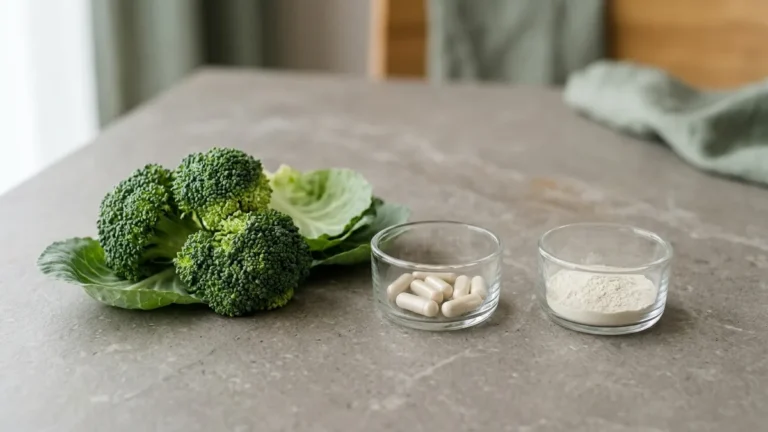

Checking Fertility Factor 5 safety starts with the label, your total zinc and selenium intake, and your medicines.
This article is part of our Male Fertility: The Complete Guide.
Short answer: Fertility Factor 5 safety cannot be confirmed from the product page, because the manufacturer names five ingredients but prints an amount for only one (200 mg of LJ100, the amount it ties to a trial) and shows no warnings. The NIH does publish upper limits of 40 mg a day for zinc and 400 mcg a day for selenium, and a cautious profile for Asian ginseng. If you take other supplements, diabetes medicine or anything that affects clotting, ask a clinician first. Read the Fertility Factor 5 official page yourself (page read 5 November 2026).
By Healthy Supplements Editorial Team | Sources read 5 November 2026
Fertility Factor 5 safety is a fair question to ask before any capsule joins your routine. Most pages about this product talk about sperm parameters, and few talk about what happens when its zinc, selenium and ginseng stack on top of what you already take. This page covers only the safety side, using figures from the NIH Office of Dietary Supplements and the National Center for Complementary and Integrative Health. If you want the wider picture first, start with our male fertility guide.
I opened twelve authority pages and the manufacturer’s page for this article and I use only numbers I read on them. Where I could not verify something, I say so. For the Fertility Factor 5 safety question that honesty matters, because the gaps are the story.
Fertility Factor 5 safety: what the label tells you and what it leaves out
On the official page (read 5 November 2026) the manufacturer states that the formula has five ingredients: LJ100, a patented Eurycoma longifolia (Tongkat Ali) extract, Panax ginseng, zinc, selenium and BioPerine, a black pepper extract. The only amount tied to the product is 200 mg of LJ100 a day, described as the amount used in a trial, with the product using the same amount. The page gives no amount for ginseng, zinc, selenium or BioPerine, no number of capsules per bottle, no directions beyond taking it daily, and no warnings beyond the standard FDA disclaimer.
The page also lists “Safe with no unwanted side-effects” among its ingredient selection criteria, and calls the zinc dose clinically proven without printing it. Those are manufacturer statements. The NIH explains that a Supplement Facts label should list the active ingredients and the amount per serving, so ask for that panel before you judge any dose. Our other Fertility Factor 5 safety comparison point is simple: you cannot check a limit against a number that is missing.
| Ingredient | What the manufacturer states | NIH reference point | Can you check Fertility Factor 5 safety? |
|---|---|---|---|
| LJ100 (Tongkat Ali extract) | 200 mg a day, tied to a trial amount | No NIH fact sheet opened for this article | Amount yes, safety no |
| Panax ginseng | No amount published | NCCIH: up to 6 months appears safe for most people in recommended amounts | No |
| Zinc | Called a clinically proven dose, no amount | RDA 11 mg for men, upper limit 40 mg a day | No |
| Selenium | No amount published | RDA 55 mcg, upper limit 400 mcg a day | No |
| BioPerine (black pepper extract) | No amount published | No NIH page could be opened | No |
Zinc and Fertility Factor 5 safety: how much is too much?
The NIH zinc fact sheet for consumers (updated 4 October 2022) gives an RDA of 11 mg a day for adult men and an upper limit of 40 mg a day for adults. It adds that these limits do not apply to people taking zinc for medical reasons under a doctor’s care. Taking too much for a long time can lead to lower immunity, low HDL cholesterol and low copper levels, and the listed short-term effects are nausea, dizziness, headaches, upset stomach, vomiting and loss of appetite.
The professional version of the zinc sheet says zinc at 50 mg or more over a period of weeks can inhibit copper absorption, and the NIH copper fact sheet says high-dose zinc supplements can interfere with copper absorption and lead to deficiency. Copper has an RDA of 900 mcg and an upper limit of 10,000 mcg for adults. That is why Fertility Factor 5 safety is really a stacking question: a zinc capsule on top of a multivitamin and a zinc lozenge adds up faster than people expect.
Medicines matter too for Fertility Factor 5 safety. The NIH says quinolone and tetracycline antibiotics and zinc can reduce each other’s absorption, with the antibiotic taken at least 2 hours before or 4 to 6 hours after zinc. Penicillamine should be taken at least 1 hour apart, thiazide diuretics increase the zinc lost in urine, and 25 mg or more of iron taken at the same time as zinc can reduce zinc absorption. The consumer sheet I read does not mention male fertility, so zinc’s role here is a nutrition question, not a proven benefit.
Selenium and Fertility Factor 5 safety: a narrow gap
The NIH selenium fact sheet for consumers (updated 18 June 2025) gives an RDA of 55 mcg a day and an upper limit of 400 mcg for adults, and notes that the European food safety authority set a lower figure of 255 mcg in 2023. Signs of too much include garlic breath, a metallic taste, hair loss, brittle nails, skin rash, nausea, diarrhea, extreme tiredness, irritability and nervous system problems, and severe excess is dangerous.
Brazil nuts show how fast selenium adds up when you think about Fertility Factor 5 safety. The sheet puts them at 68 to 91 mcg per nut, so four nuts is 272 to 364 mcg before any capsule. On benefit, the consumer sheet says it is unclear whether selenium supplements improve sperm quality, and the professional sheet says there is not enough data to determine whether selenium supplements significantly affect male fertility. For Fertility Factor 5 safety, that means selenium adds a possible overshoot without a proven fertility payoff.
Panax ginseng and Fertility Factor 5 safety: who should check first
NCCIH’s Asian ginseng page (last updated February 2025) says short-term oral use, up to 6 months, in recommended amounts appears safe for most people, while long-term safety is questioned. Insomnia is the most common side effect. Uncommon reports include severe rash, liver damage and severe allergic reactions. It says Asian ginseng may worsen autoimmune disorders, may interfere with blood clotting, and might lower blood sugar, so people with diabetes should consult their provider.
The same page says some research suggests benefit for erectile dysfunction, but it does not discuss sperm or fertility. Because this product does not publish its ginseng amount, I cannot judge Fertility Factor 5 safety for this ingredient or tell whether it sits in what NCCIH calls a recommended amount. NCCIH’s guide to using supplements wisely (last updated January 2019) adds that some supplements can increase bleeding risk or affect your response to anesthesia, so tell your surgeon about any supplement before a procedure.

LJ100 and BioPerine: what I could not verify
I did not open an NIH safety page for Tongkat Ali or for BioPerine in this run, and the NCCIH black pepper page returned an error, so I make no safety claim about either. Our Tongkat Ali fertility page covers the research question separately. For BioPerine, the practical step is to ask a pharmacist whether a black pepper extract matters for the medicines you take. Honest Fertility Factor 5 safety advice sometimes means saying where the evidence stops.
Adding it up: a stack check before you start
The NIH guide to what you need to know about supplements (updated 4 January 2023) tells people to share every supplement they take with their providers and notes that natural does not always mean safe. MedlinePlus says not to take a bigger dose than the label recommends. Use that to run your own Fertility Factor 5 safety check:
- List every supplement, multivitamin and fortified product you take, with the zinc, selenium and iron on each label.
- Ask the seller or read the bottle’s Supplement Facts panel for the zinc and selenium amounts in this product, because the page I read does not show them.
- Add the amounts and compare the total with 40 mg of zinc and 400 mcg of selenium.
- Note any antibiotics, diuretics, diabetes medicines or blood thinners, and check timing with a pharmacist.
- Tell your clinician before you start, and stop and call them if you notice side effects.
Who should ask a clinician about Fertility Factor 5 safety before starting
- Anyone on blood thinners or with a clotting disorder: NCCIH says ginseng may interfere with blood clotting.
- Anyone with diabetes: NCCIH says ginseng might lower blood sugar.
- Anyone taking quinolone or tetracycline antibiotics, penicillamine or thiazide diuretics: the NIH describes zinc interactions with each.
- Anyone with an autoimmune disorder: NCCIH says ginseng may worsen these.
- Anyone already taking zinc, selenium, iron or a multivitamin: your total may already be near the limits.
- Anyone with surgery planned: NCCIH says some supplements affect bleeding or anesthesia response.
If the real goal is a pregnancy, Fertility Factor 5 safety is only part of it, and a clinician can also order and interpret a semen analysis and look for causes a supplement will not fix. Our semen analysis timeline guide explains how to track results.
The 67-day guarantee and the 3-month test
The manufacturer states a 100% satisfaction guarantee of 67 days, described as 60 days plus a week of return shipping (page read 5 November 2026). Its FAQ says to return the bottles even if empty, while the guarantee section says to return the unused portion, so confirm the wording with the seller before you rely on it. On my 4 November 2026 read, the page also said to test semen after at least 3 months of use. That is longer than the refund window, which is a reason to plan the timeline with a clinician. A 67-day window does not replace a safety check, and Fertility Factor 5 safety should be settled before you open the first bottle.
How this fits with our other Fertility Factor 5 pages
Different pages answer different questions, and this Fertility Factor 5 safety guide deliberately skips the efficacy debate. Use does Fertility Factor 5 work for the verdict question, the ingredients review and the full label breakdown for ingredient detail, and the reviews page and the five-brand comparison for buying context. For the broader evidence, see do male fertility supplements work and male fertility vitamins: the evidence.
Fertility Factor 5 safety verdict
Verdict: the honest Fertility Factor 5 safety answer is “unknown until the amounts are known.” Nothing I read on NIH pages says the named ingredients are unsafe at ordinary label doses, but the product page does not print enough to check zinc, selenium or ginseng against the published limits, and it shows no warnings or interaction guidance. Treat the manufacturer’s “safe” line as a claim to verify, not a finding. If you want to try it, get the Supplement Facts amounts, add up your other supplements, and talk to a clinician first if any of the groups above applies to you.
Check the Fertility Factor 5 label and guarantee
Fertility Factor 5 safety FAQ
Is Fertility Factor 5 safe?
The manufacturer calls it safe with no unwanted side-effects, but that is a marketing statement, not a safety assessment, and the page I read prints an amount for only one of five ingredients. Fertility Factor 5 safety depends on your total zinc and selenium intake, your medicines and your health history, so ask a clinician if any of those apply.
How much zinc is in Fertility Factor 5?
The official page I read on 5 November 2026 calls the zinc dose clinically proven but does not print the amount. The NIH reference points are an RDA of 11 mg a day for adult men and an upper limit of 40 mg a day, so check the Supplement Facts panel on the bottle before adding other zinc.
How much selenium is too much?
The NIH Office of Dietary Supplements gives an upper limit of 400 mcg a day for adults and an RDA of 55 mcg. Garlic breath, a metallic taste, hair loss and brittle nails are listed among the signs of too much.
Can Fertility Factor 5 interact with medicines?
The page lists no interactions. Per the NIH, zinc can reduce absorption of quinolone and tetracycline antibiotics and of penicillamine, and thiazide diuretics increase zinc lost in urine. NCCIH says Asian ginseng may interfere with blood clotting and might lower blood sugar.
Is Panax ginseng safe for men trying to conceive?
NCCIH says short-term oral use, up to 6 months, appears safe for most people in recommended amounts, with insomnia as the most common side effect. Its page does not discuss sperm or fertility, and the ginseng amount in this product is not published.
Does Fertility Factor 5 have side effects?
The official page names none. The NIH lists nausea, dizziness, headaches, upset stomach, vomiting and loss of appetite for too much zinc, and NCCIH lists insomnia, and rarely rash, liver damage or allergic reactions, for ginseng.
Can I take Fertility Factor 5 with a multivitamin?
Only after adding up the zinc and selenium on both labels. NIH also notes that 25 mg or more of iron taken at the same time as zinc can reduce zinc absorption, so a clinician or pharmacist can help with timing.
What should I do if I get side effects?
NCCIH advises stopping the supplement and contacting your health care provider if you have side effects, and telling your providers about every supplement you take.
Is the safe, no side effects claim proven?
Not on the page I read, which gives no citation for it. The FDA says firms are responsible for evaluating the safety of their products before marketing, and the NIH says supplements are not approved for safety or effectiveness before they reach consumers.
How long is the Fertility Factor 5 money-back window?
The page states 67 days, described as 60 days plus a week of return shipping. Its FAQ says to return bottles even if empty, while another section says to return the unused portion, so confirm the exact terms with the seller.
Sources opened for this Fertility Factor 5 safety article
- NIH ODS, Zinc fact sheet for consumers (updated 4 October 2022)
- NIH ODS, Zinc health professional fact sheet
- NIH ODS, Selenium fact sheet for consumers (updated 18 June 2025)
- NIH ODS, Selenium health professional fact sheet
- NIH ODS, Copper fact sheet for consumers (updated 18 October 2022)
- NCCIH, Asian ginseng (last updated February 2025)
- NCCIH, Using dietary supplements wisely (last updated January 2019)
- NIH ODS, What you need to know about dietary supplements (updated 4 January 2023)
- NIH ODS, Dietary supplements: background information (updated 11 March 2020)
- FDA, Dietary supplements (content current as of 1 October 2024)
- MedlinePlus, Dietary supplements (last updated 20 November 2025)
- USP, Dietary Supplement Verification Program
- Fertility Factor 5 official page (manufacturer, read 5 November 2026)
The USP program is voluntary and evaluates submitted products against quality standards, so ask the seller whether this product has been through any independent verification.
See the official Fertility Factor 5 page
Affiliate disclosure: we earn a commission if you buy through our links, at no extra cost to you. These statements have not been evaluated by the Food and Drug Administration. This product is not intended to diagnose, treat, cure, or prevent any disease. This page is for information only and is not medical advice.