Sensoril vs KSM-66 is the first question most people ask about ashwagandha and cortisol. Below: what the human trials actually measured, where the evidence is thin, and what it means if you are choosing a stress-support supplement.
Reviewed by Dr. John Carter, PharmD, CNS (Clinical Pharmacist & Lead Scientific Reviewer). Written by Emily Wallace, RD. Sources were opened on PubMed, PMC and NIH on 2026-10-11.
Quick answer: No head-to-head trial has compared Sensoril with KSM-66, so neither can honestly be called the winner. Both are standardized ashwagandha extracts with their own small, mostly manufacturer-linked trials. A 2025 meta-analysis found ashwagandha lowers cortisol on average but did not significantly change perceived stress. Compare dose, extract type and measured outcome, not brand claims. Check the ingredients and current offer on the official CortiSync page.
Table of Contents
Disclosure: this page contains affiliate links. We may earn a commission if you buy through them, at no extra cost to you. This is educational information, not medical advice.
What does “ashwagandha extract” actually mean?
What is ashwagandha, and why do extracts differ?
Ashwagandha (Withania somnifera) supplements are not one product. Raw root powder, a full-spectrum root extract, an aqueous root extract and a root-plus-leaf extract differ in what they contain and how much of the active withanolides they concentrate. Percent-withanolide numbers on two different labels are measured and defined differently, so they cannot be compared like for like.
NIH’s Office of Dietary Supplements notes that studies use varied preparations and doses, which is one reason the evidence on stress is described as mixed. Our broader overview is in Ashwagandha for Stress.
How KSM-66 and Sensoril are made: root-only vs root and leaf
- KSM-66: a root-only, high-concentration full-spectrum extract made by Ixoreal Biomed (named in the full text of Chandrasekhar 2012).
- Sensoril: an aqueous extract of root and leaf (per the STAR trial, PMID 30463324).
- Shoden: another branded root extract (Lopresti 2019, PMID 31517876).
- Unbranded root aqueous extract: Salve 2019, PMID 32021735.
What do KSM-66 trials show about cortisol?
The KSM-66 cortisol trial: what Chandrasekhar 2012 found
Chandrasekhar, Kapoor and Anishetty (Indian Journal of Psychological Medicine, 2012; PMID 23439798) ran a double-blind, placebo-controlled trial in 64 adults with a history of chronic stress. They took 300 mg of KSM-66 twice daily for 60 days. Stress scores improved versus placebo (P<0.0001) and serum cortisol was lower versus placebo (P=0.0006). Adverse effects were mild and comparable to placebo.
Limits of the KSM-66 cortisol evidence
The limits matter: one centre, 64 people, 60 days, and the extract was supplied by its manufacturer. We opened only one KSM-66 cortisol trial for this article, so we do not claim the full KSM-66 literature is summarized here. Our CortiSync review covers how a multi-ingredient formula is judged.
What do Sensoril trials show?
Sensoril in research: the Ziegenfuss trial
Ziegenfuss and colleagues (Nutrients, 2018; PMID 30463324), the STAR trial, gave Sensoril aqueous root-and-leaf extract at 500 mg per day versus placebo for 12 weeks alongside resistance training in 38 recreationally active men. Strength, power, a 7.5 km time trial and perceived recovery improved, and it was well tolerated. The outcome was not cortisol, so this trial cannot be used as cortisol evidence.
Sensoril original stress trial: what was measured
Sensoril’s original stress trial (Auddy et al., 2008) is described in trade-press summaries. We could not locate the paper in PubMed, so we do not build any claim on its figures.
What do other branded and unbranded extracts show?
Other ashwagandha extracts: the trial list
- Lopresti et al., Medicine 2019 (PMID 31517876): 60 stressed healthy adults, 240 mg per day of Shoden extract for 60 days; greater morning-cortisol reduction than placebo (P<.001).
- Salve et al., Cureus 2019 (PMID 32021735): 60 stressed adults, root aqueous extract at 250 or 600 mg per day versus placebo for 8 weeks; serum cortisol lower at both doses (P<0.05 and P<0.0001) and perceived stress lower. The authors declared no competing interests, and the abstract does not name a brand.
Cortisol reductions appear across several different extracts at roughly 240 to 600 mg per day. The signal is “standardized root extract”, not one brand. Other adaptogens are compared here.
What does the 2025 meta-analysis conclude?
What the 2025 meta-analysis found on cortisol
Albalawi and colleagues (Nutrition and Health, 2025; PMID 40746175) pooled randomized trials of at least 2 weeks at 250 mg per day or more: 7 studies on cortisol, 6 on perceived stress, 488 participants. Cortisol fell by a mean 1.16 µg/dL (95% CI -1.64 to -0.69, P<0.001). Perceived stress did not change significantly (SMD -0.355, 95% CI -1.188 to 0.47, P=0.40). Heterogeneity was moderate (I² 50.9%), risk of bias moderate, and the authors flag gaps in long-term safety data.
Why a lab cortisol change is not the same as feeling less stressed
A lab-measured cortisol change does not automatically mean people feel less stressed. How cortisol is tested explains what the numbers can and cannot tell you.
Sensoril vs KSM-66: why can’t we declare a winner?
| Question | KSM-66 | Sensoril |
|---|---|---|
| Cortisol trials opened for this article | 1 (n=64) | 0 (the STAR trial measured strength) |
| Extract type | Root-only, full-spectrum | Aqueous, root and leaf |
| Funding or supply | Manufacturer-supplied extract | 2008 stress trial not located in PubMed |
| Head-to-head trial | None found | None found |
Sensoril vs KSM-66: popular claims vs the evidence
In the Sensoril vs KSM-66 debate, populations, doses, assays and durations differ; samples are small; and manufacturers are involved. Counting trials, as some competitor pages do, measures marketing history rather than effectiveness. See how we compare formulas.
Sensoril vs KSM-66: how do they compare side by side?
Sensoril vs KSM-66 side by side: plant part, extraction, key trials
In a Sensoril vs KSM-66 comparison, the honest differences are in how the extracts are made and how much research exists, not in proven results. KSM-66 is described as root-only and full-spectrum; Sensoril is an aqueous extract of root and leaf. Each has a handful of published human trials, and none compares one directly with the other.
| Feature | KSM-66 | Sensoril |
|---|---|---|
| Plant parts | Root | Root and leaf |
| Extraction | Full-spectrum, high concentration | Aqueous |
| Trial opened with cortisol outcome | Chandrasekhar 2012 | None found |
| Trial opened with other outcome | Stress scores (same trial) | Strength and recovery (STAR, 2018) |
| Direct comparison | No trial found | |
So a Sensoril vs KSM-66 verdict based on trial counts, price or marketing is a guess. What can be said is that several standardized root extracts have lowered cortisol in small, short trials. Compare other adaptogenic supplements.
What dose range do experts discuss for ashwagandha extract?
What NIH says about ashwagandha dose ranges
NIH reports that a provisional recommendation from the WFSBP and CANMAT taskforce suggests 300 to 600 mg per day of root extract for generalized anxiety disorder, while stating it cannot make a stronger recommendation without more data. That is a clinical-guideline context, not a recommendation for cortisol, and it does not apply to every extract. In a Sensoril vs KSM-66 decision, the dose per day matters more than the brand name on the bottle.
Does the choice affect sleep?
Sleep results in the ashwagandha trials
Salve 2019 reported improved sleep quality versus placebo with a root aqueous extract over 8 weeks, but the brand was not named, so it cannot settle Sensoril vs KSM-66. Sleep outcomes for either branded extract were not opened for this article. For sleep and cortisol timing, see our cortisol and sleep guide.
What doses did the trials use compared with the CortiSync label?
| Source | Extract | Daily dose | Duration | Cortisol measured? |
|---|---|---|---|---|
| Chandrasekhar 2012 | KSM-66 | 600 mg | 60 days | Yes |
| Salve 2019 | Root aqueous extract | 250 or 600 mg | 8 weeks | Yes |
| Lopresti 2019 | Shoden | 240 mg | 60 days | Yes |
| Ziegenfuss 2018 (STAR) | Sensoril | 500 mg | 12 weeks | No |
| CortiSync label | Sensoril (plus six other ingredients) | 300 mg per 2 capsules | n/a | n/a |
How the CortiSync label dose was read
The label figure is read from the supplement-facts image on the manufacturer’s page on 2026-10-11. Do not treat any row as equivalent to another: different extracts, different people, different purposes. Label directions are explained here.
What would a fair head-to-head trial look like?
Design of a fair Sensoril vs KSM-66 trial
A fair Sensoril vs KSM-66 trial would randomize participants to each extract at matched, labeled doses against placebo, measure salivary or serum cortisol at the same times of day, and record perceived stress, sleep and safety labs. It would be registered in advance, funded independently of both manufacturers, and large enough to detect differences between the extracts, not only differences from placebo. Until that exists, any ranking is opinion.
Practical next steps for readers
Readers who want practical next steps can track their own sleep, mood and side effects, and ask a clinician about cortisol testing. Our cortisol testing guide explains the options.

Is ashwagandha safe, and who should avoid it?
Safety cautions from NIH
NIH’s Office of Dietary Supplements reports ashwagandha is generally well tolerated in studies lasting up to about three months, and that long-term safety is unknown. Reported effects include stomach upset, loose stools, nausea and drowsiness.
- Liver: NIH LiverTox describes clinically apparent liver injury linked to commercial products labeled as containing ashwagandha, usually recovering after stopping, with rare severe cases mostly in people with existing liver disease. Stop and seek care for jaundice, dark urine or itching.
- Thyroid: evidence is mixed, with case reports of thyrotoxicosis and possible interaction with thyroid hormone medicine.
- Pregnancy and breastfeeding: NIH notes some experts advise against use; French agency ANSES recommends against it.
- Medicines: possible interactions with thyroid, diabetes, blood-pressure, immunosuppressant and sedative drugs.
When to talk to your doctor first
Ask your doctor or pharmacist before starting, especially if you take any of these medicines. Read our CortiSync side effects guide.
Where does Sensoril fit inside CortiSync?
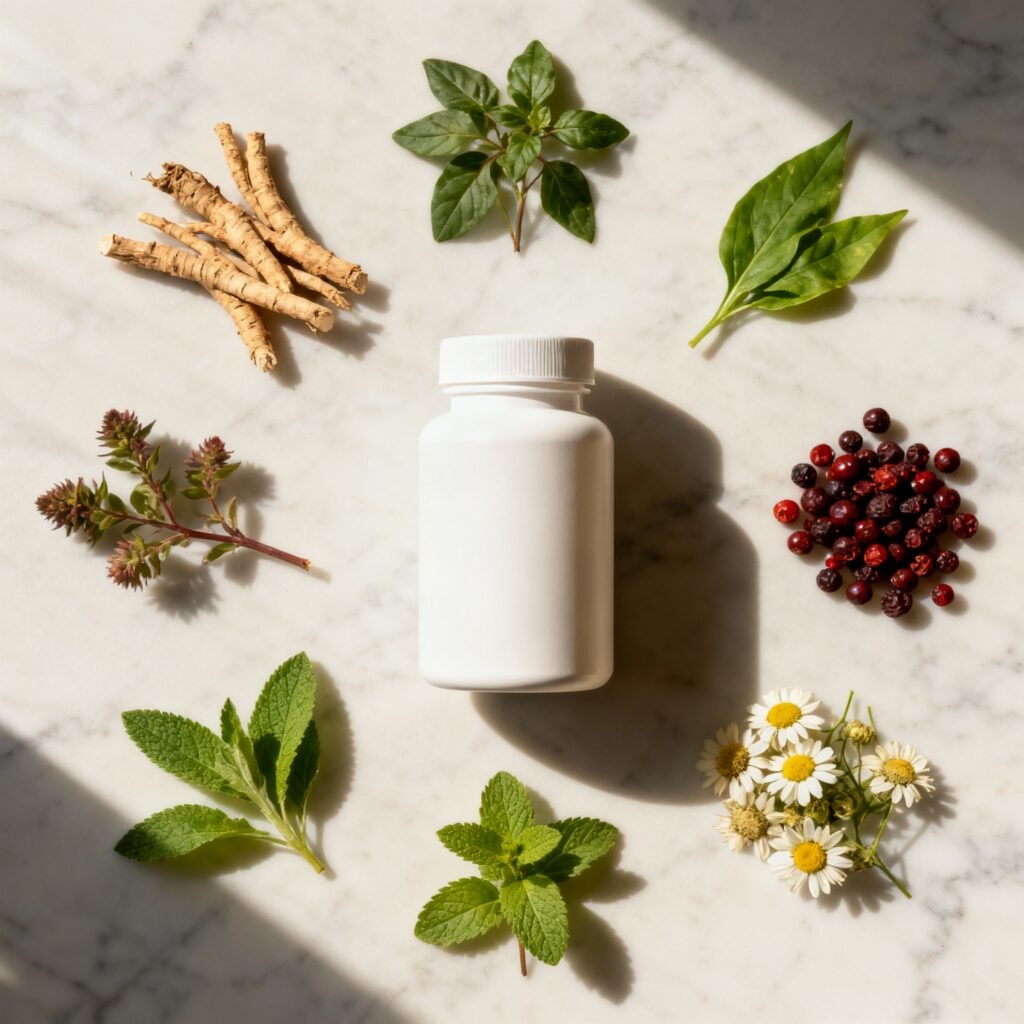
The manufacturer states that CortiSync combines seven ingredients, led by Sensoril ashwagandha. The label we read lists, per two-capsule serving: Sensoril 300 mg, lemon balm 150 mg, lichi fruit extract 120 mg, L-theanine 100 mg, holy basil leaf extract 100 mg, magnolia bark extract 100 mg and rhodiola root extract 50 mg. The page does not cite studies for the combination, so the trials above describe single ashwagandha extracts, not CortiSync itself.
The manufacturer’s own statements about results are claims, not independent findings. If a multi-ingredient formula appeals to you, check the full label and terms yourself on the official CortiSync page. Our detailed breakdown is in the CortiSync ingredient guide.
CortiSync label facts and current offers
Supplement Facts per serving (2 capsules, 30 servings per bottle), as printed on the label: Sensoril ashwagandha root extract 300 mg, lemon balm powder 150 mg, lichi fruit extract 120 mg, L-theanine 100 mg, holy basil leaf extract 100 mg (2% ursolic acid), magnolia bark extract 100 mg, rhodiola root extract 50 mg (3% rosavins, 1% salidroside).
According to the official CortiSync page: take 2 capsules daily with a meal; the maker says most people notice changes from around week 2; every order is covered by a 67-day money-back guarantee; USA shipping is free on select orders; the 6-month Best Value package works out to under $54 per month; and the 3- and 6-month packages include free bonus gifts: the Ultimate E-Guide to Reducing Your Cortisol Levels ($19.95 retail value) and a complimentary bottle of DIM 3X ($69.95 retail value). Offers can change, so confirm the current terms on the order page.
See today’s CortiSync offer and bonus gifts (affiliate link: https://www.cortisync.com/ct/618161)

How should you choose between Sensoril vs KSM-66 products?
Checklist: how to choose an ashwagandha product
- Check the extract type (root-only or root-plus-leaf) and the daily dose, not just the withanolide percentage.
- Look for doses in the range used by trials (about 240 to 600 mg per day) and be cautious of unlabeled blends.
- Prefer products with third-party testing or a certificate of analysis you can read.
- Check your own situation: pregnancy, thyroid, liver, and medicines.
- Start one change at a time and record sleep, mood and side effects for 8 weeks.
- Ignore Sensoril vs KSM-66 pages that crown a winner by trial counts alone.
Frequently asked questions
Is Sensoril vs KSM-66 a fair fight: which lowers cortisol more?
Nobody can say. No head-to-head trial has compared the two, and the cortisol trials we could open used other extracts or different outcomes. In Sensoril vs KSM-66, choose by dose, extract type and quality testing rather than brand claims. Compare the ingredient list in our CortiSync ingredient guide.
How much ashwagandha extract did the cortisol trials use?
The trials we opened used roughly 240 to 600 mg per day of standardized root extract for 8 to 12 weeks. The 2025 meta-analysis only included trials of at least 2 weeks and 250 mg per day. See how to take CortiSync for label directions.
Does ashwagandha lower cortisol but not stress?
On average, yes in one 2025 meta-analysis: pooled cortisol fell by 1.16 µg/dL, while perceived stress did not change significantly. Individual trials report better stress scores, so results are mixed. Read the broader picture in our ashwagandha for stress guide.
How long does ashwagandha take to work on cortisol?
Trials measured cortisol after 8 to 12 weeks, not days. NIH notes most studies are short and small, so long-term effects are unknown. Plan on weeks, not days, and track how you feel. Check the official CortiSync page for the manufacturer’s own timeline claims.
Is ashwagandha safe for everyone?
No. NIH lists cautions for pregnancy, breastfeeding, thyroid conditions, liver disease and people taking sedatives, thyroid, diabetes or blood-pressure drugs. Rare liver injury has been reported with ashwagandha products. Ask a clinician first and read our CortiSync side effects guide.
How much Sensoril is in CortiSync?
The label on the manufacturer’s page shows 300 mg of Sensoril ashwagandha root extract per two-capsule serving, alongside six other ingredients. We read it on 2026-10-11. See the full label breakdown on the official CortiSync page.
Can I take ashwagandha with other adaptogens?
Many formulas combine them, but combinations have not been tested as a whole in the trials above. Add one product at a time and ask a pharmacist about your medicines. Compare formulas in CortiSync vs competitors.
Why do different brands list different withanolide percentages?
Extracts are made and measured by different methods, so a percentage on one label is not directly comparable to another. Root-only and root-plus-leaf extracts also differ. Judge by dose per day and independent testing. Start with the ingredient guide.
Methodology and limitations
We opened each cited record on PubMed, PMC or NIH on 2026-10-11 and report only what those pages state. We found no Sensoril vs KSM-66 head-to-head trial, we read only a subset of the ashwagandha literature, and most trials are small, short and sometimes manufacturer-supplied. Product facts are attributed to the manufacturer and dated. This article is educational and not a substitute for medical advice.
See the CortiSync label for yourself. The manufacturer lists Sensoril ashwagandha first among seven ingredients. Check the full Supplement Facts, directions and guarantee terms on the official page: https://www.cortisync.com/ct/618161
Affiliate link: we may earn a commission at no extra cost to you. Educational information, not medical advice. Ask your doctor before starting any supplement.
Medical reviewer: Dr. John Carter, PharmD — Clinical Pharmacist & Lead Scientific Reviewer. Board-certified Pharmacist (BPS), Certified Nutrition Specialist (CNS).
Author: Emily Wallace, RD — Clinical Nutritionist & Content Director. Registered Dietitian (RD).
Medical disclaimer: information only; not diagnosis or treatment. Affiliate disclosure: links to cortisync.com are affiliate links.
About the Author