Affiliate disclosure: some links on this page are affiliate links. If you buy through them we may earn a commission at no extra cost to you.
By Healthy Supplements Editorial Team
GenuinePurity Trans-Resveratrol Label: What the Supplement Facts Panel Says
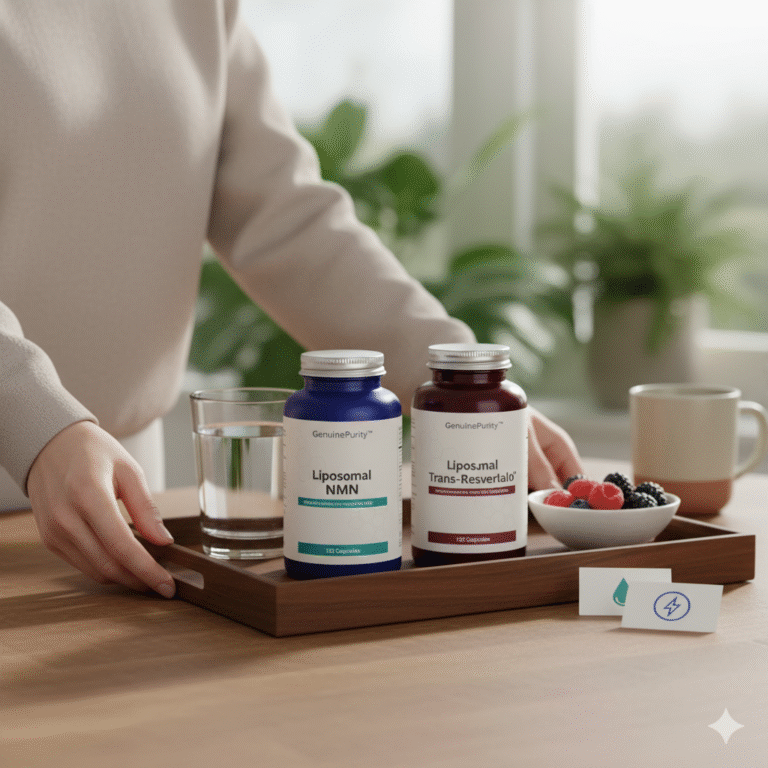
Before you buy any resveratrol capsule, it helps to read the Supplement Facts panel line by line. This page walks through the label on GenuinePurity Liposomal Trans-Resveratrol, shows what the maker page states, and sets both next to what a National Institutes of Health source says about resveratrol.
Short answer: the label lists 500 mg of micronized trans-resveratrol (from Polygonum cuspidatum root extract) per serving of 2 vegetable capsules, with 30 servings per container. The NIH LiverTox entry says there is no conclusive evidence that resveratrol has beneficial effects in humans. A label tells you what is in the bottle. It does not tell you that the product works.
Label read from the maker’s Supplement Facts image on 27 November 2026
What does the Supplement Facts panel list?
We read the Supplement Facts image on the official GenuinePurity product listing on 27 November 2026. Panels can change with a new batch, so check the bottle you receive.
| Label line | What it says |
|---|---|
| Serving size | 2 vegetable capsules |
| Servings per container | 30 (60 capsules in total, by our arithmetic) |
| Micronized trans-resveratrol | 500 mg per serving, from Polygonum cuspidatum (root) extract |
| % Daily Value | Marked “daily value not established” |
| Other ingredients | Vegetable cellulose (capsule), microcrystalline cellulose, phospholipid complex (sunflower lecithin, phosphatidylcholine), silicon dioxide, vegetable stearate |
The 500 mg figure is per serving, not per capsule. If the two capsules are split evenly, each holds about 250 mg, but the label does not state a per-capsule amount.
What does the maker page state?
These items are attributed to the official GenuinePurity pages as read on 27 November 2026. They can change, so confirm them at checkout.
| Item | What the official page says |
|---|---|
| How to use | Take 2 capsules per day, preferably with food, or as directed by a health professional |
| Price | Product listing shows 59 USD for 1 bottle and lists it as in stock |
| Guarantee | 97-day money-back guarantee stated on the product page |
| Testing | Page says products are tested by third party laboratories and refers to Certificates of Analysis; open the certificate yourself before buying |
| Manufacturing | Page says products are made in cGMP-certified facilities in the United States |
We do not repeat the maker’s benefit wording here. A refund policy also says nothing about whether a product works.
See the maker page for current terms
What does NIH say about resveratrol?
The NIH LiverTox entry on resveratrol (last updated 30 November 2024, read 27 November 2026) says the following (NCBI Bookshelf, LiverTox: Resveratrol):
- At present there is no conclusive evidence that resveratrol has beneficial effects in humans.
- Human trials have used doses from 20 mg to 5 g daily, and it describes a typical over-the-counter dose as 500 mg twice daily.
- The purity of commercial products is rarely well defined, and oral bioavailability is poor.
- Side effects may include minor stomach upset, nausea, headache and fatigue, and possible interactions with estrogens and anticoagulants.
- Rare, mild liver enzyme rises were reported in some trials, mostly at high doses (1.5 to 3 g daily). It judges clinically apparent liver injury from resveratrol to be unlikely.
How does the label compare with those doses?
The label lists 500 mg per serving of 2 capsules, which is inside the range of doses used in trials. That is a statement about amount only. It does not show that this product, or any amount of resveratrol, produces a benefit. The label also does not give the percentage of trans-resveratrol in the root extract, so the 500 mg figure is as stated by the maker.
What does one published certificate of analysis look like?
The maker’s certificate page (genuinepurity.com certificates of analysis, read 27 November 2026) links PDF reports for its liposomal trans-resveratrol. I opened both PDFs. This is a worked example of how to read them, not a check of the bottle you would receive.
Manufacturer certificate for “Liposomal Resveratrol 250 mg VCapsules”, batch 23J002, date of manufacture 10/2023
What it shows: Finished capsules: target weight 525 mg (result 521 mg), disintegration 10 minutes against a limit under 30, trans-resveratrol 250.000 mg specified at not less than 90% of label claim, result 101.12% by HPLC (a finished-capsule figure, not raw-material purity). Lead 0.026 ppm, arsenic 0.010 ppm, mercury 0.130 ppm, cadmium 0.005 ppm, all under the listed limits.
What it does not show: A 2023 batch. It does not certify the batch in a bottle bought now.
Separate laboratory report for the same batch 23J002, received 20 October 2023 (potency and heavy metals) and 24 October 2023 (microbiology)
What it shows: Trans-resveratrol by UPLC (accession 231020-0123, received 20 October 2023, reported 31 October 2023): 252.805 mg per capsule against a 250.000 mg per capsule specification. Lead, arsenic, mercury and cadmium by ICP-MS with the same four results as above. Microbiology: total plate count and yeast and mold under 10 cfu/g, coliforms under 10 cfu/g, E. coli, S. aureus and Salmonella/Shigella absent in 10 g.
What it does not show: It is an old finished-capsule result for one batch, not verification of a bottle bought now. The report states its results represent the samples submitted and may not reflect the whole batch.
How to use this: find the lot number printed on your own bottle, then ask the maker for the certificate for that lot. A certificate for another batch, or for raw material, says little about your capsules. This page does not state that the current product meets these results.
What should you check on any resveratrol label?
- Is the serving size clear, and is the amount per serving, not per capsule?
- Does it say trans-resveratrol and name the source?
- Is there a certificate of analysis you can open and match to the batch?
- What are the other ingredients, in case you avoid soy, dairy or other additives?
- What are the return terms, and what must you send back?
Who should talk to a clinician first?
Ask a doctor or pharmacist before starting resveratrol if you take blood thinners or estrogen-containing medicines, have a liver condition, are pregnant or nursing, or are under 18. LiverTox lists possible interactions with anticoagulants and estrogens.
Frequently asked questions
How much trans-resveratrol is in one serving?
The label lists 500 mg of micronized trans-resveratrol per serving, and a serving is 2 capsules.
Does the label show a daily value?
No. It marks the daily value as not established.
Does the label prove the product works?
No. A label states contents. LiverTox says there is no conclusive evidence of benefit in humans.
What does the maker say about returns?
The official page states a 97-day money-back guarantee. Read the current terms at checkout.
References
- LiverTox: Resveratrol, NCBI Bookshelf (read 27 November 2026)
- GenuinePurity Liposomal Trans-Resveratrol official page (how to use and guarantee, read 27 November 2026)
- GenuinePurity certificates of analysis page and the two linked trans-resveratrol PDF reports for batch 23J002 (read 27 November 2026)
- GenuinePurity product listing (price and availability, read 27 November 2026)
For the wider picture on longevity supplements, see our NMN evidence review and the supplement label checklist.
These statements have not been evaluated by the Food and Drug Administration. This product is not intended to diagnose, treat, cure or prevent any disease. This article is educational and is not medical advice. Talk to a clinician before starting a supplement.
Page updated 27 November 2026. Sources checked that day: NCBI Bookshelf LiverTox resveratrol entry, the GenuinePurity trans-resveratrol product page, listing and Supplement Facts image, and the maker-hosted certificate of analysis PDFs for batch 23J002.